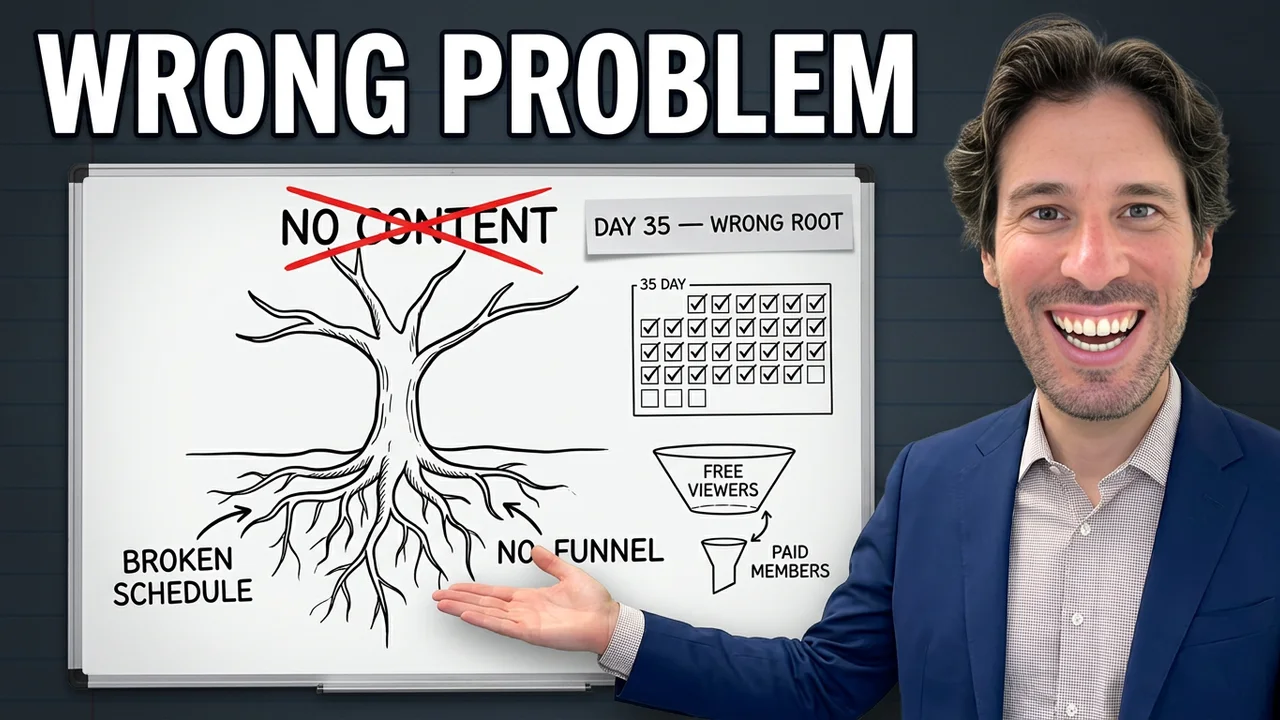
What did 35 days of daily vibe-coding actually produce?
After 35 days of live vibe-coding, I had built a habit — and almost nothing else. No reusable content sat inside iCharles.com. No funnel existed to move a viewer toward a paid membership. I had been showing up Monday through Friday, going live for roughly 3 hours, then coding solo, then shooting a single video. That schedule felt productive. It was not. The real output was a growing gap between effort and membership value.
At [0:00] I said: "every single brainstorming session is important for other people to think of ideas or features" — which is exactly why I filmed this one instead of keeping it private.
Why does objective problem identification matter more than the solution?
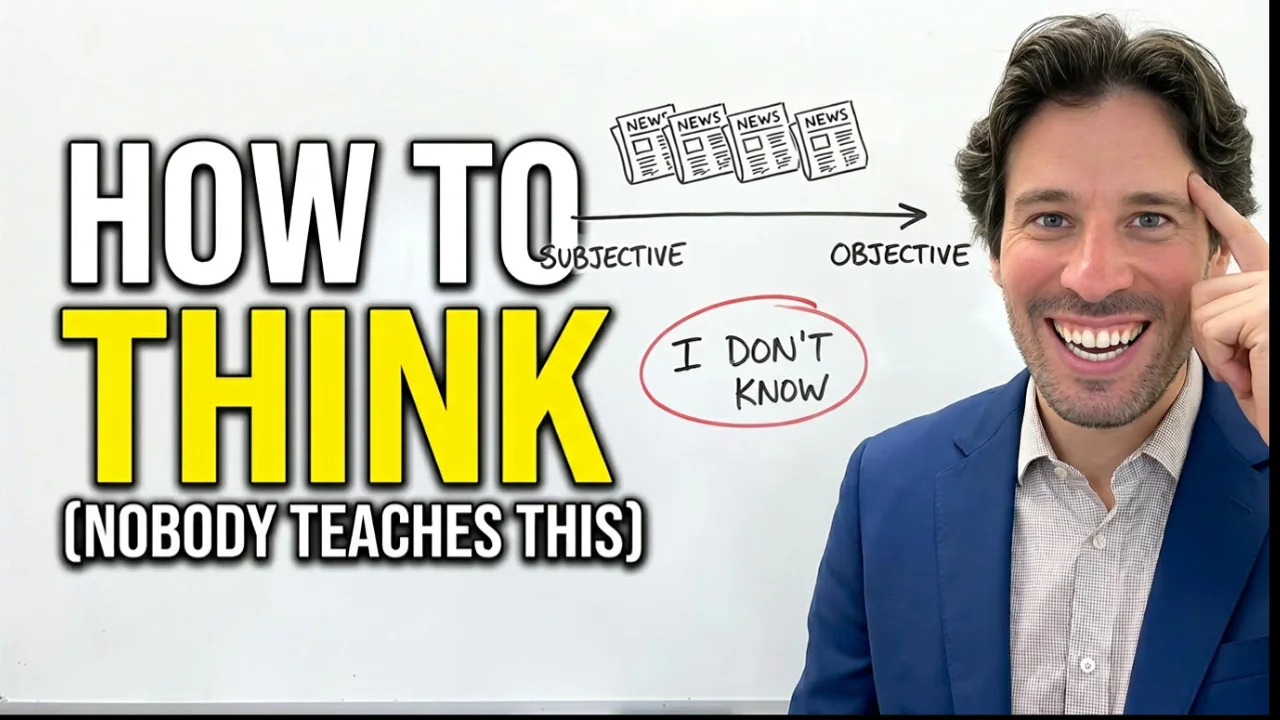
Most founders jump to solutions before they have a clean problem statement. I kept catching myself doing it during this session. The discipline I kept returning to is the gap between how things are and how you want them to be. One is reality. The other is preference. Brainstorming only works when you stay anchored to reality.
I landed on 2 distinct, separate problems by the end of the session. First: no content on iCharles.com, meaning a paying member who joined today would find an empty library. Second: no funnel — no structured path from YouTube viewer to subscriber to paying member. Naming both cleanly felt like real progress.
How does my value proposition differ from Matt Miller's?
Matt Miller — the Bridge Mind Bridge Voice creator and, by my account, something like the grandfather of vibe coding — had reached 190-plus days of daily vibe-coding and what he cited as $191 in annual recurring revenue at the time I watched his stream. His value is educational AI content delivered on X, paired with daily entertainment. He has built an audience there over roughly 150 more days than I have.
I am not Matt. My value is personal development through video. That distinction matters because it changes what content I need to produce and where I need to distribute it. Trying to replicate his X-first content strategy would be misaligned with what iCharles actually offers.
You might also like
What is the viewer-to-member conversion funnel I am building toward?
The funnel has 4 stages, and each one requires a reason to move forward:
- A viewer watches a YouTube video and finds enough value to subscribe.
- A subscriber returns regularly and begins to trust the content.
- A regular viewer decides they want more and considers paying.
- A paying member joins iCharles.com and finds an abundance of content waiting.
The closing rate I am targeting is 3–4%. By my own account, 4–5% is the kind of number that gets a salesperson flown to Antigua on a company trip. Three to four is realistic. But that math only works if step 4 delivers — and right now, step 4 is empty.
The Nielsen Norman Group research on conversion rates and funnel design reinforces what I already knew intuitively: conversion collapses when the destination fails to match the promise made earlier in the funnel. My YouTube presence was making a promise my membership site could not keep.
Why did I move video hosting from a Mac Studio to Cloudflare?
The Mac Studio was my original answer to video delivery. I had been saying for months: own everything, run local models, keep it on your own hardware. That position made sense philosophically. It broke down practically. RAM limits, storage constraints, and dependence on my own ISP all surfaced as real problems once I framed the question correctly: if my value is high-quality video, can a Mac Studio reliably deliver that to members?
The answer was no. So I moved to Cloudflare Stream for hosting. Yes, it costs money. But the trade-off is clear.
| Factor | Mac Studio hosting | Cloudflare Stream |
|---|---|---|
| RAM and storage ceiling | Low, hits limits fast | Scales with usage |
| ISP dependency | Yes — my connection is the bottleneck | No — Cloudflare's network |
| Customization and branding | Full control | Full control |
| Reliability at scale | Uncertain | Purpose-built for delivery |
Becoming humble about that trade-off was the harder part. I had built an identity around owning the stack. Letting go of it for the right reason — member experience — was the actual decision.
Should I have spent 35 days vibe-coding before fixing the content problem?
I asked myself this directly during the session: did I waste 35 days? My answer was no — but not because the output was great. The 35 days built the habit. Vibe-coding is now ingrained. I show up even on days I do not want to. That consistency is the foundation everything else gets built on top of.
What the 35 days also did was surface the real problem. I thought my schedule was fine. It took 35 days of running that schedule to see clearly that it was the root cause of the content gap. You cannot diagnose a broken system from the outside. Sometimes you have to run it long enough to see where it fails.
The YouTube content strategy documentation makes a related point: a channel's growth depends on consistent, structured output that serves a defined audience — not just volume. I had volume. I did not have structure aimed at a defined outcome.
What questions do builders ask when diagnosing a stalled membership site?
How do I know if my membership site has a content problem or a traffic problem? If you have traffic arriving but no conversions, the problem is almost always content or trust — the destination is not delivering on the promise. If you have no traffic, the funnel has not started yet. In my case, I had both: thin YouTube presence and an empty membership library. Fixing one without the other would not have moved the number.
What is a realistic viewer-to-paying-member conversion rate for a solo creator? By my own working estimate, 3–4% is a solid target. That means for every 100 people who watch regularly, 3 or 4 will eventually pay. Four to five percent is exceptional — the kind of rate that marks a top performer. Most solo creators land below 3% when their content-to-trust pipeline is not fully built out.
How long does it take for daily vibe-coding to become a real habit? I hit the habit threshold somewhere around day 34 or 35. Common figures I have heard range from 3 weeks to 60 days depending on the behavior. For me, the marker was simple: I show up even when I do not want to. The behavior no longer requires a decision. That is the threshold worth targeting, not a specific day count.
Why is it a problem to be "subjective toward the outcome" in brainstorming? When you want the outcome to be a certain way, you filter evidence to support that preference. You call a bad schedule "productive" because you want it to be. Objective brainstorming means following the evidence to wherever it leads, even if it reveals that 35 days of effort produced the wrong output. The goal is truth, not confirmation.
What is the difference between a surface problem and a root problem in a content strategy? A surface problem is what you can see immediately — "I have no content on my site." A root problem is the cause underneath — "my daily schedule produces nothing that belongs in a content library." I spent most of this session peeling from surface to root. The surface problem points at what is missing. The root problem tells you what to change.
0 Comments
Log in to comment
Not a member yet? Join the community
Pick a meme
KlipyHave a great take?
Drop your email — we'll send a magic link so you can post it. No password.
Not a member of the community? Join today.
Join the community →