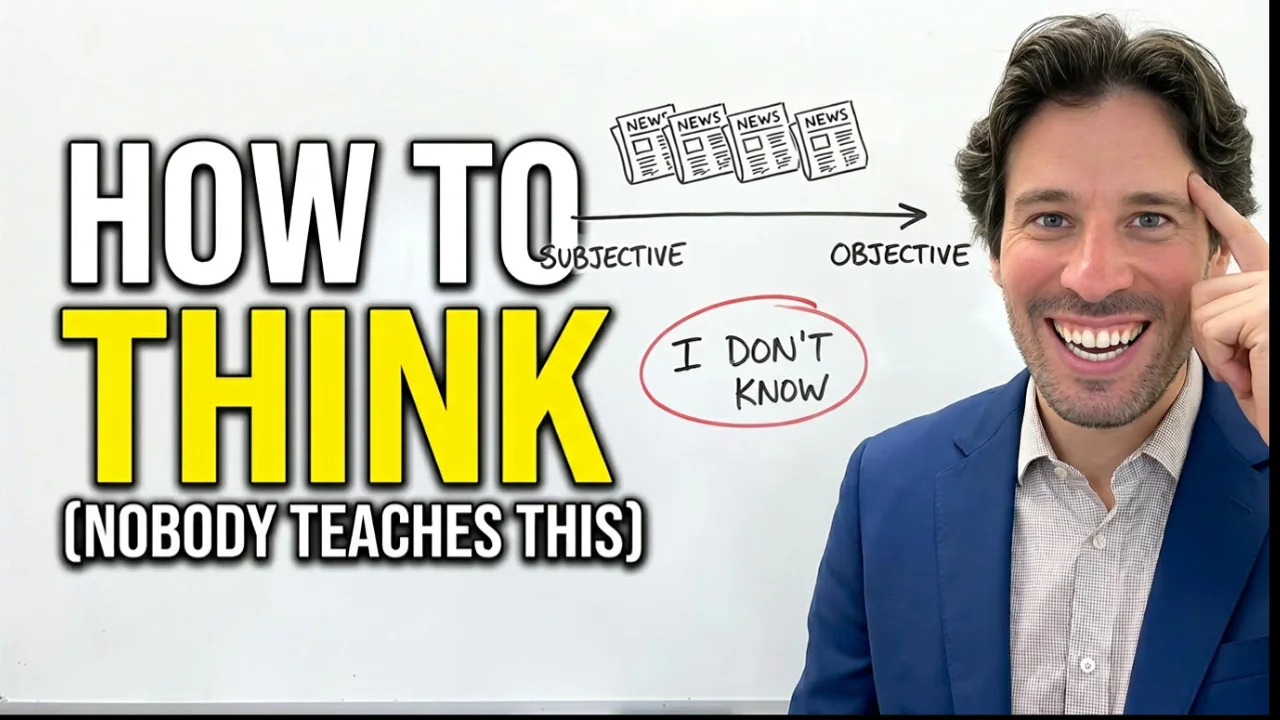
What is the core framework for thinking objectively?
Objective thinking is a practice, not a personality trait — and it starts with removing noise before adding knowledge. Charles Botensten has been running this whiteboard system for over a decade, and the structure is deceptively simple: silence first, humility second, "I don't know" third. Most people skip all three and wonder why their thinking keeps looping back to the same emotional conclusions.
The framework sits on a spectrum. On one end is pure subjectivity — "my truth," high emotion, low signal. On the other is objective reality, which Charles acknowledges no one reaches completely. The goal is movement along that spectrum, not arrival at some perfect endpoint.
At [0:00] I said: "We're never going to be completely 100% objective on every single issue. It is impossible because there is an objective reality, yes — but we are not, because we're sinners, we're not the best people." That framing matters because it removes the perfectionism trap. You're not trying to become a logic machine. You're trying to reduce the emotional noise enough to see more clearly.
Why does silence come before everything else?
Every philosopher Charles has studied, every mathematician, every scientist — they all returned to the same habit: walking in silence. Not podcasts. Not music. Silence. The reason is structural. You cannot hear a new idea if the channel is already full.
Charles traces his own turning point to 2011, walking back to his Wall Street real estate office on a hot day in a suit. He passed a newsstand and counted 8 or 9 national newspapers — the Wall Street Journal, the Financial Times, the New York Times, the Washington Post, the New York Post, the LA Times — all running the exact same story with different headlines and different camera angles on the same photo. One angle made the subject look heroic. Another made them look threatening.
That moment cracked something open. He cancelled his Newsweek subscription that week. The realization was not that media lies — it was that media selects. And if you are not in silence long enough to notice the selection, you absorb the frame without knowing it.
How does humility function as a thinking tool?
Humility here is not a soft virtue. It is an epistemic tool. Charles defines it operationally: humility is the act of saying "I don't know" before you start, which clears the space for accurate information to enter.
You might also like
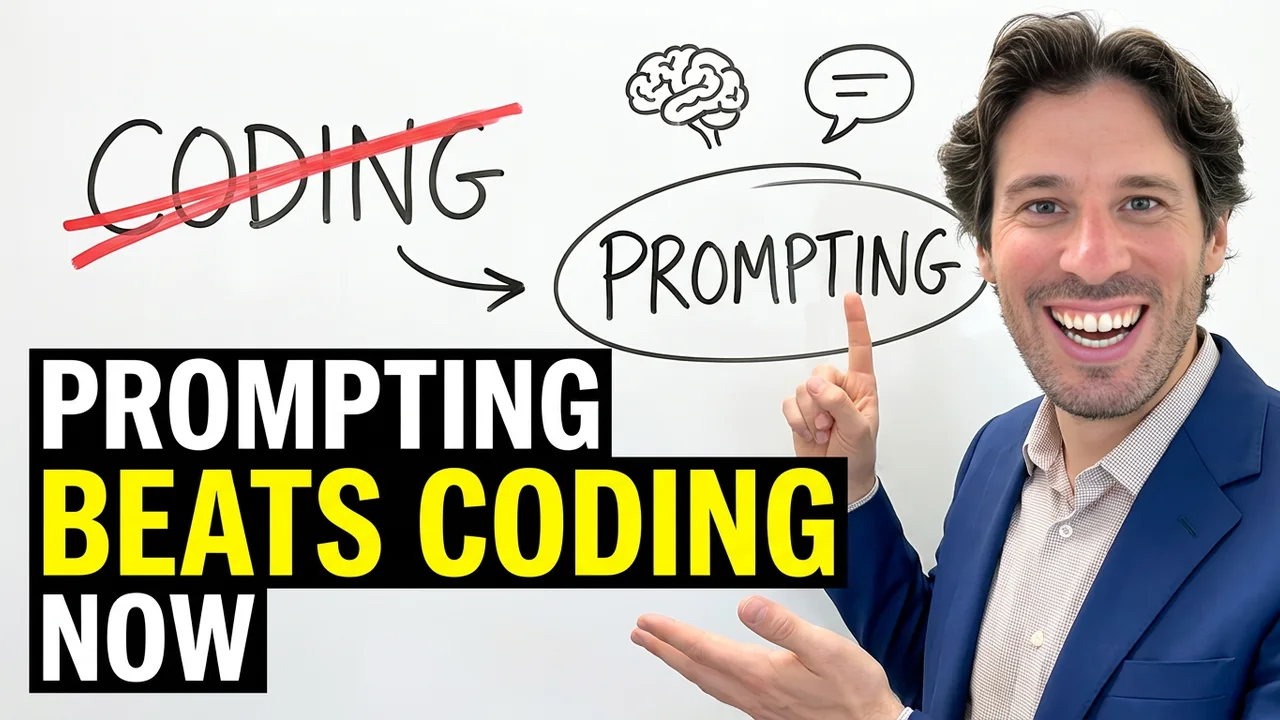
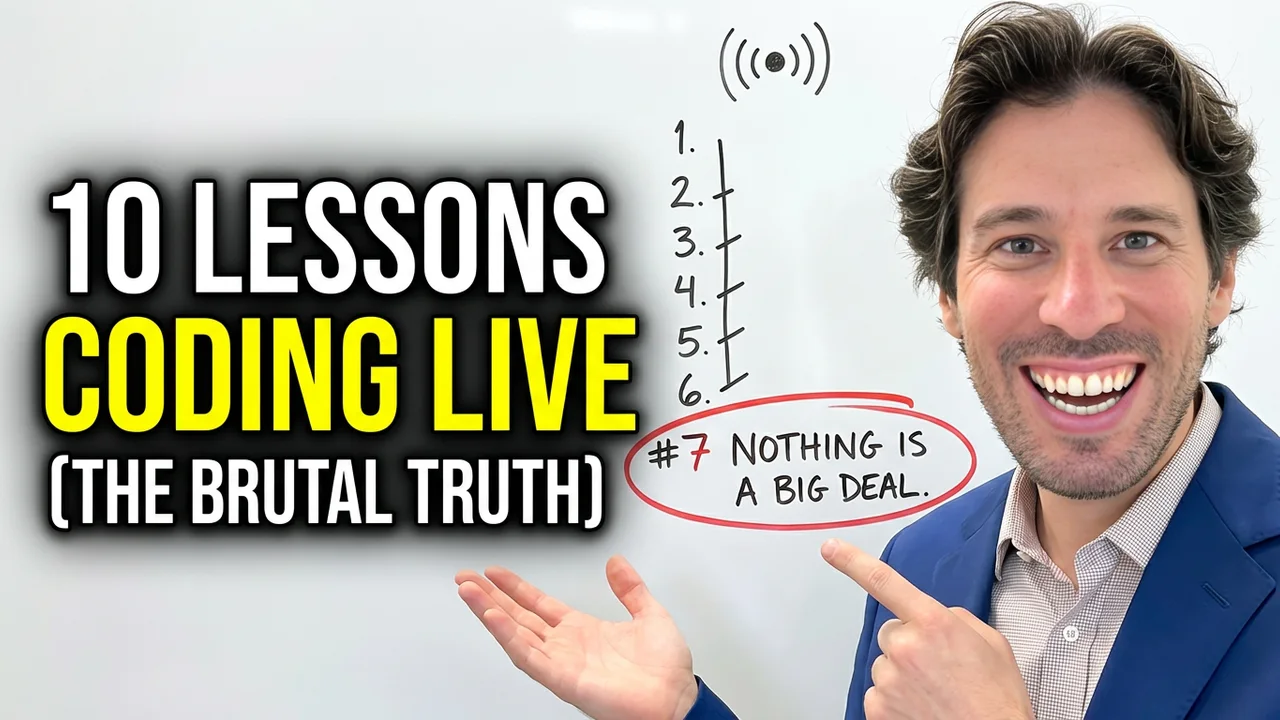
He runs through a list of things he genuinely did not know 5 months before this recording: what a markdown file is, how to vibe-code, how to build and host a web application. Every one of those skills is now part of his daily workflow. The entry point was identical each time — "I don't know" — followed by going to find out.
The process he describes looks like this:
- Identify the problem in plain language — no jargon, no blame.
- Sit in silence long enough to separate the problem from the emotion around it.
- Say "I don't know" and mean it — resist the urge to perform competence.
- Go find the person, video, or documentation that does know.
- Apply what you learn, then re-evaluate honestly.
This is not a motivational framework. It is the actual sequence Charles used to move from self-hosted video on a Mac Studio to a Cloudflare-based hybrid player — a decision made live on stream after weeks of defending the opposite approach.
Has the Pareto Principle shifted in the social media era?
The Pareto Principle is the observation, attributed to economist Vilfredo Pareto, that roughly 20% of inputs produce 80% of outputs — 20% of crops yield 80% of food, 20% of players score 80% of goals, 20% of real estate agents do 80% of the business.
Charles's position is that the original 80/20 ratio no longer holds. His reasoning: Pareto was working with a world population of perhaps 1–2 billion people and far less media saturation. Today, with social media consuming the attention of billions, Charles estimates the ratio has compressed to something closer to 95/5 — 5% of people, businesses, or players producing 95% of the meaningful output. He says he would accept 90/10 as a conservative version of the same idea.
The implication is not fatalistic. It means the gap between distracted and focused thinking has widened, not narrowed. Which means the return on actually doing the silence-and-humility work is higher now than it was when Pareto first ran his numbers.
| Ratio | Context Charles describes | His confidence level |
|---|---|---|
| 80/20 | Pareto's original era, smaller population | Historical baseline |
| 90/10 | Conservative modern estimate | "A little more fair" |
| 95/5 | Charles's actual working estimate | His stated view |
What does this have to do with building in public and vibe-coding?
The whiteboard framework is not abstract philosophy for Charles — it runs directly into his technical decisions on stream. The clearest example from this session is the video infrastructure pivot.
For weeks, Charles had been arguing that you can build anything you want, host it yourself, and never depend on a third-party platform. Then his Mac Studio hit its limits. The bandwidth, the storage, the encoding — his own ISP setup could not reliably deliver video to members across different Wi-Fi environments.
The honest accounting: YouTube encodes and delivers reliably at scale. Cloudflare Stream gives him a customizable player with bandwidth he does not have to manage himself. Wistia has security. Vimeo has aesthetics. His self-hosted setup had none of those properties at the quality level he wanted.
The decision to pivot to a Cloudflare hybrid — his video player, their servers — cost him the consistency of his public position. He had told his community for 3 weeks that self-hosting was the move. Humbling himself meant admitting, on camera, that it was not. That is the framework applied in real conditions, not hypothetical ones.
What questions do builders and thinkers ask about this process?
How long does it actually take to shift from subjective to more objective thinking? Charles is direct about the timeline: over 5 years of unlearning, then another 5 years of relearning. He entered personal development in 2009 and says he only began thinking truly objectively around 3 to 4 years before this recording. He does not soften that number. It is a long process, and he says so plainly.
Does "I don't know" work as a starting point for technical skills, not just life philosophy? Yes — and Charles uses vibe-coding as the proof case. Five months before this recording, he did not know what a markdown file was. He applied the same sequence: silence, humility, "I don't know," then learn. Markdown, Cloudflare configuration, and live stream infrastructure all entered his working knowledge through that same door.
Why is creation the antidote to distraction? Charles's argument is structural. Consumption is passive and keeps you inside someone else's frame. Creation forces you outward — you have to ask what other people want, what value you are delivering, what problem you are solving. That outward orientation is incompatible with the purely emotional, self-referential thinking he associates with high distraction. It does not matter what you create: a chair, a painting, a website, a community.
What went wrong with the self-hosted Mac Studio video setup? The Mac Studio could not handle the bandwidth, storage, or encoding demands of live community video at the quality Charles wanted. His own ISP was the bottleneck. YouTube handles encoding and adaptive delivery automatically. Cloudflare Stream handles bandwidth at scale. The self-hosted approach was philosophically clean but practically insufficient — and the stream is where he admitted that publicly.
Is the 95/5 estimate Charles cites an established statistic? No — and Charles does not present it as one. It is his own read on how the Pareto ratio has shifted given social media saturation and population growth. He offers 90/10 as a more conservative version of the same intuition. Neither figure comes from a study he cites. They are his working estimates, stated as such.
0 Comments
Log in to comment
Not a member yet? Join the community
Pick a meme
KlipyHave a great take?
Drop your email — we'll send a magic link so you can post it. No password.
Not a member of the community? Join today.
Join the community →