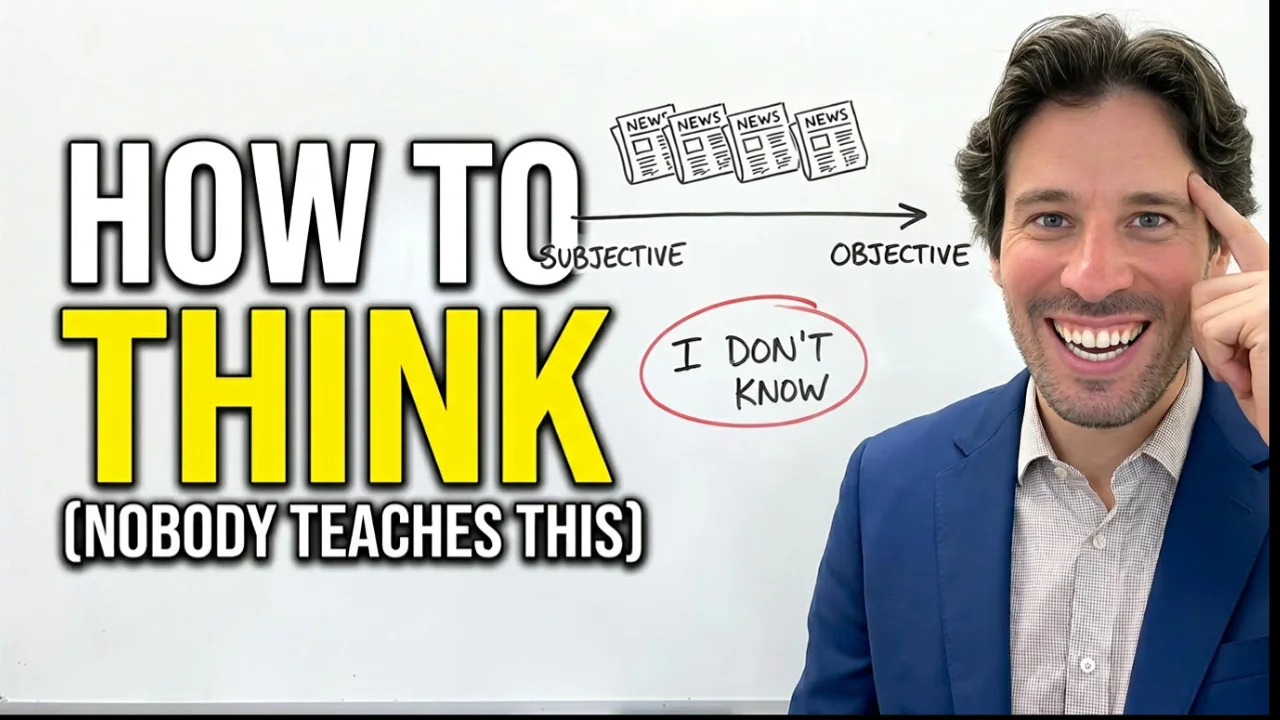
What is the core framework for thinking objectively?
Objective thinking is not a personality trait — it is a practiced discipline built on 2 prerequisites: silence and humility. I spent over 10 years getting there. Five years unlearning the media-shaped, emotionally reactive worldview I absorbed without noticing. Five more years rebuilding a cleaner mental model from scratch. The framework I drew on the whiteboard this week is the same one I now apply to every decision — from infrastructure choices to community strategy at iCharles.
The spectrum runs from purely subjective (high emotion, "my truth") to as-close-as-possible to objective (low emotion, grounded in observable reality). I put most people at 75–80% on the subjective side. That is not a character flaw. It is the default output of an environment engineered to keep attention fragmented.
Why did I spend 5 years unlearning before I could think clearly?
The turning point was a specific afternoon in 2011. I was in my second year as a real estate agent in New York City, walking back to my office near Wall Street after showing an apartment just south of the Trade Center site. I passed a newsstand carrying 8 or 9 papers — the Wall Street Journal, the Financial Times, the New York Times, the New York Post, the LA Times, the Washington Post. Every single one ran the same story. Different headline. Different camera angle on the photo. If the editorial slant was positive, the subject was photographed from below, smiling. If the slant was negative, the shot looked down, the expression was a frown.
At that moment I understood something I could not un-see: the story was not the story. The angle was the story. I had been reading the Wall Street Journal financial reporting cover to cover every day, believing I was educating myself. I was. But I was also absorbing a curated frame without realizing it. I cancelled my Newsweek subscription that week.
How does emotional thinking block objective reality?
Emotion and subjectivity move together on the spectrum. The more emotionally reactive a thought is, the less it reflects what is actually happening and the more it reflects what I want or fear to be happening. That is not a spiritual claim — it is a practical one. Anger, pride, and tribalism all compress the information I let in.
My father passed away in 2019. COVID followed immediately. That two-year stretch forced a kind of involuntary silence I had not chosen. It also accelerated the relearning phase. I only started thinking with real consistency closer to the objective end of the spectrum about 3 to 4 years ago, despite being in personal development since 2009.
Humility is the mechanism that bridges silence and objectivity. It is also the word, as I said on the whiteboard, that almost nobody uses anymore.
You might also like
What does "I don't know" actually unlock?
At the whiteboard I kept returning to one phrase as the entry point for every skill: "I don't know." Not as defeat — as a starting position. I listed examples out loud: I don't know how to code. I don't know how to vibe code. I don't know how to build. I don't know how to public speak. I don't know social media. Each one is just a skill. And as I said during the session:
At [0:00] I said: "Every skill can be learned. Not every skill will be mastered, but every skill can be learned" — which reframes the gap between ignorance and competence as a distance problem, not an identity problem.
Five months ago I had no idea what a markdown file was. I had no idea how Claude processed instructions. I started from zero, said I don't know, and treated it like any other learnable skill. The same logic applies to relationships, marketing, and infrastructure decisions.
Has the Pareto principle shifted in the social-media era?
The Pareto principle is the observation — first documented by economist Vilfredo Pareto — that roughly 20% of inputs produce 80% of outputs. The Pareto principle — the 80/20 rule explained has been validated across agriculture, wealth distribution, sports, and business for over a century.
My argument on the whiteboard is that the ratio has moved. When Pareto was working, global population was closer to 1–2 billion. The concentration was real but the competition was thinner. Now, with social media absorbing the attention of billions, I think the distribution looks more like this:
| Ratio | What it describes |
|---|---|
| 80/20 (Pareto's era) | 20% of agents produce 80% of results — lower population, less distraction |
| 90/10 (conservative update) | Concentration increases as competition for attention grows |
| 95/5 (my current estimate) | 5% of businesses, players, coaches, and creators capture 95% of outcomes |
I am willing to soften it to 90/10 to be fair. But I do not think 80/20 describes the current environment. The floor of competition has not risen — it has collapsed, because most people are consuming, not creating.
Why is creation the structural opposite of distraction?
Creation forces outward orientation. When I am vibe coding a feature for the iCharles community, I have to ask: what do the members actually want? What is the value here? That question pulls me out of my own emotional frame and into something more objective. Consumption — scrolling, watching, reacting — does the opposite. It keeps the loop closed inside my own preferences and reactions.
I am not prescribing a content type. On the whiteboard I listed chairs, benches, paintings, murals, instruments, gardens, websites, and businesses as equivalent. The act of making something for someone else is what matters. It is the practical mechanism for escaping the 95% and moving toward the 5%.
What did the Cloudflare decision reveal about applied humility?
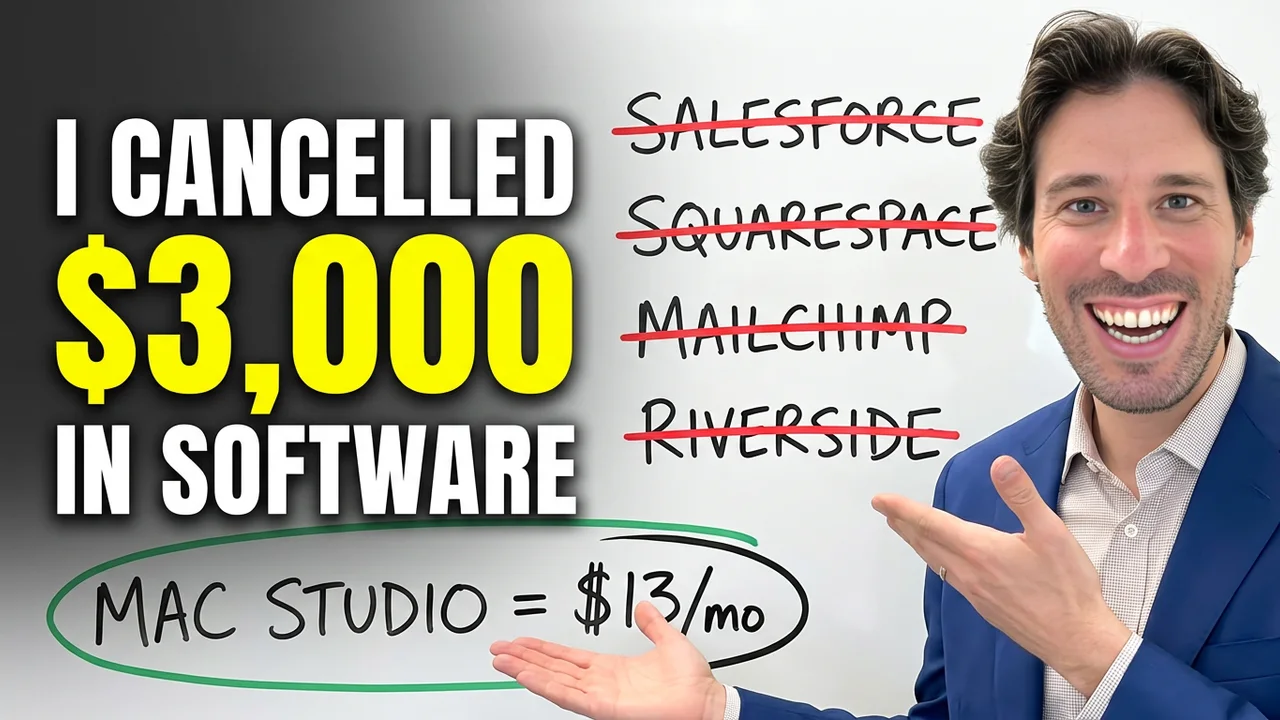
The infrastructure decision I made live this week is the clearest recent example of this framework in action. My Mac Studio could not handle the bandwidth, storage, or encoding demands of streaming video to the iCharles community. I had been saying publicly for 3 weeks that you can build anything you want, host it yourself, never depend on anyone else's servers.
Then reality pushed back. YouTube encodes reliably across every Wi-Fi environment. I do not control that — the viewer's ISP does. I wanted a custom video player with the security of Wistia and the flexibility of Vimeo, without YouTube's interface. The Cloudflare Stream developer documentation showed a path: my player, their servers. A hybrid. I pay for bandwidth. I get the customization. I lose the self-hosting purity I had been defending.
The honest summary: I humbled myself mid-stream, made a 90-degree turn against everything I had said publicly for 3 weeks, and moved toward what actually works. That is the framework applied to a real technical decision. Silence reveals the problem. Humility removes the ego blocking the solution. "I don't know" opens the path forward.
What questions do builders and thinkers ask about this framework?
Does objective thinking mean having no emotions? No. The goal is not to eliminate emotion — it is to reduce the degree to which emotion distorts perception. I place the target somewhere between 60–40 and 70–30 on the objective side of the spectrum. Complete objectivity is impossible because we are human, shaped by upbringing, experience, and belief. The work is directional, not absolute.
How long does it realistically take to shift from subjective to more objective thinking? In my case, over a decade. Five years of unlearning media-shaped and emotionally reactive patterns, then five more years of deliberately rebuilding. I started personal development work in 2009 and only felt genuinely clear-headed about 3 to 4 years ago. The timeline varies, but anyone expecting a fast result is still in the subjective frame.
What is the first practical step toward more objective thinking? Silence. Not meditation as a brand — just the removal of input. No news feed, no background audio, no social scroll. The mind needs unstructured time to surface its own signal. Every philosopher and mathematician I referenced on the whiteboard — the ones who went on long walks — were doing exactly this. They were creating conditions for thought, not consuming conditions for reaction.
Why does humility matter more than intelligence in this framework? Intelligence without humility produces confident wrong answers. The "I don't know" starting position is not a weakness — it is the only honest entry point into any new domain. I had no idea what a markdown file was 5 months ago. Pretending otherwise would have blocked every lesson that followed. Humility is the gate that lets new information in.
Is this framework religious or secular? Both, honestly. I referenced objective truth and the reality that we are imperfect — that we have bad thoughts, anger, and bias baked in. That framing is grounded in my faith. But the practical mechanics — silence, humility, saying "I don't know," moving toward creation — apply regardless of worldview. The whiteboard is not a sermon. It is a systems diagram that happens to be consistent with how I understand human nature.

0 Comments
Log in to comment
Not a member yet? Join the community
Pick a meme
KlipyHave a great take?
Drop your email — we'll send a magic link so you can post it. No password.
Not a member of the community? Join today.
Join the community →