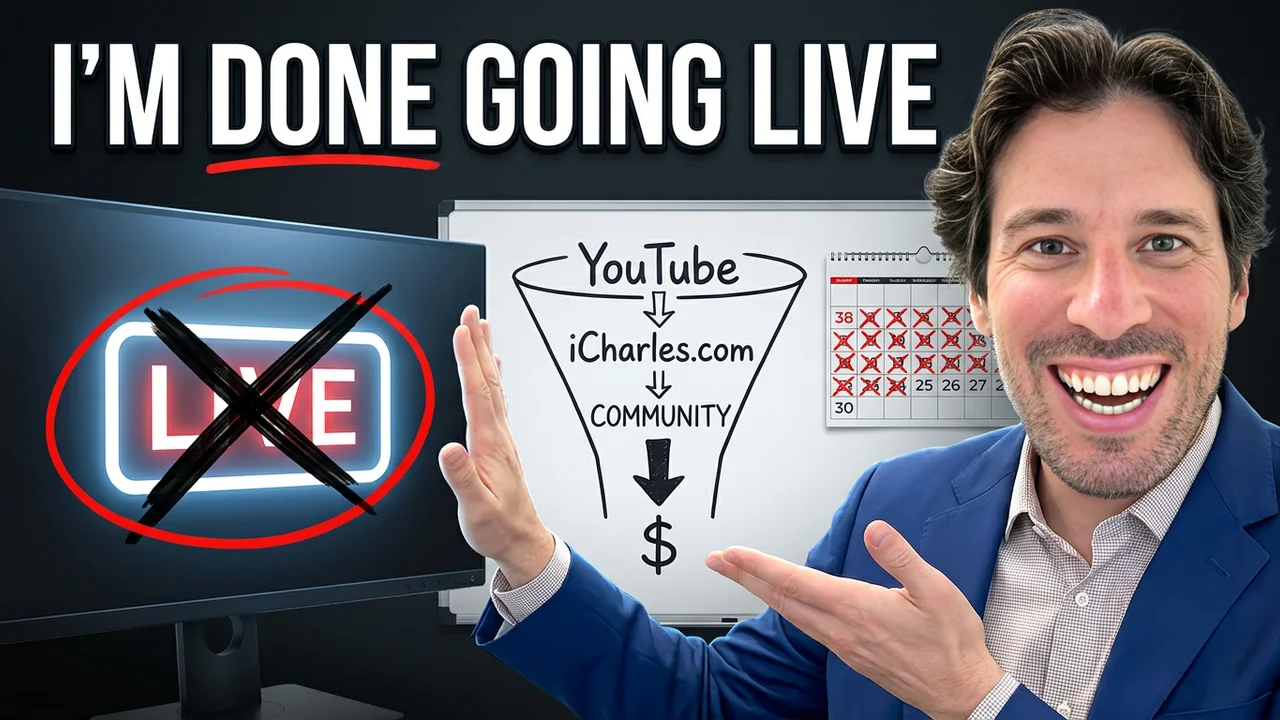
Why did I stop treating daily live vibe-coding as my core product?
The daily live format was eating the exact hours I needed to produce real content. I had been going live on YouTube every day from 9 a.m. to 1 p.m. — 3 to 4 hours of vibe-coding per session. By the time I finished, I needed another 3 to 4 hours to recover. That left nothing for writing, editing, or publishing the articles and videos that actually move people through my funnel.
At [1:23] I said: "I'm good at vibe coding. I'm better at silent strategy. I'm better at silent building" — and that admission is what forced the whole pivot. Recognizing where your actual skill sits is harder than it sounds when you've already committed publicly to a format.
The problem was structural, not motivational. I am the value in this model. If I am not producing content, no value reaches anyone — not casual YouTube viewers, not subscribers, not paying members of the iCharles community. The live stream was consuming the resource it was supposed to generate.
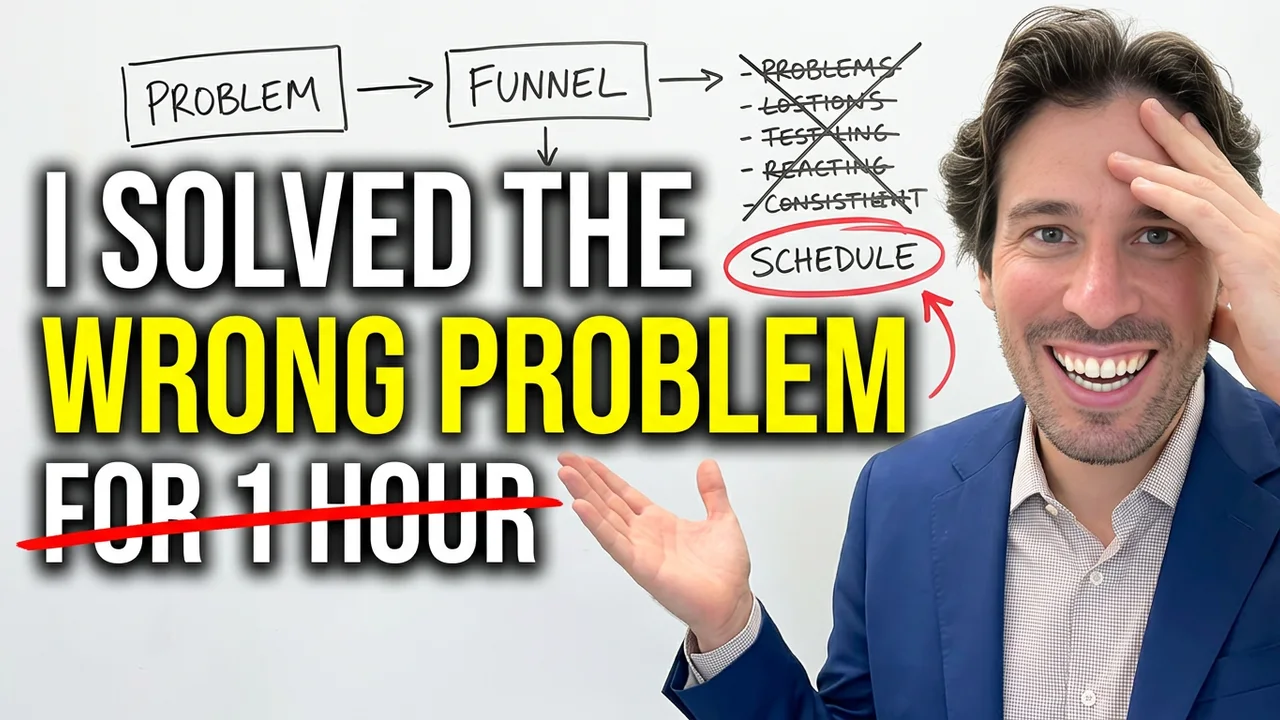
What is the iCharles content funnel and how does it work?
The funnel has 4 stages: casual viewer, viewer, subscriber, and paying member. Each stage requires a different kind of content, and YouTube sits at the very top.
- A casual viewer finds a YouTube video and watches it once.
- Enough value keeps them coming back — they become a regular viewer.
- Consistent value earns a subscription.
- Deeper access — more content, community posts, events — converts a subscriber into a paying member of iCharles.
My marketing is entirely organic right now. Paid advertising requires something to brag about — a community that is visibly active, with posts, replies, shares, and DMs. A community with a dozen people coming in and out is not that yet. So the funnel has to be fed by volume of content, not ad spend.
How does iCharles.com fit into the SEO and AEO strategy?
Every YouTube video becomes an article. Every article lives on iCharles.com. That double-publish approach hits two separate discovery channels at once: video search and text search. And beyond Google, it targets what I'm calling AEO — answer engine optimization for AI models like Perplexity, Bing's AI layer, and others that scrape the open web for structured content.
I had 34,000 hits in a single month on a site that was, by my own description, a really bad static website with almost nothing on it. The crawlers were already coming. The question was whether there would be anything worth indexing when they arrived.
Articles are not dead. Every major AI model is scraping the internet. I watched the traffic logs and was genuinely surprised by which domain was sending the most referrals — it wasn't a search engine or a knowledge base I would have predicted. That confirmed the bet: publish text, publish it consistently, make it structured.
You might also like
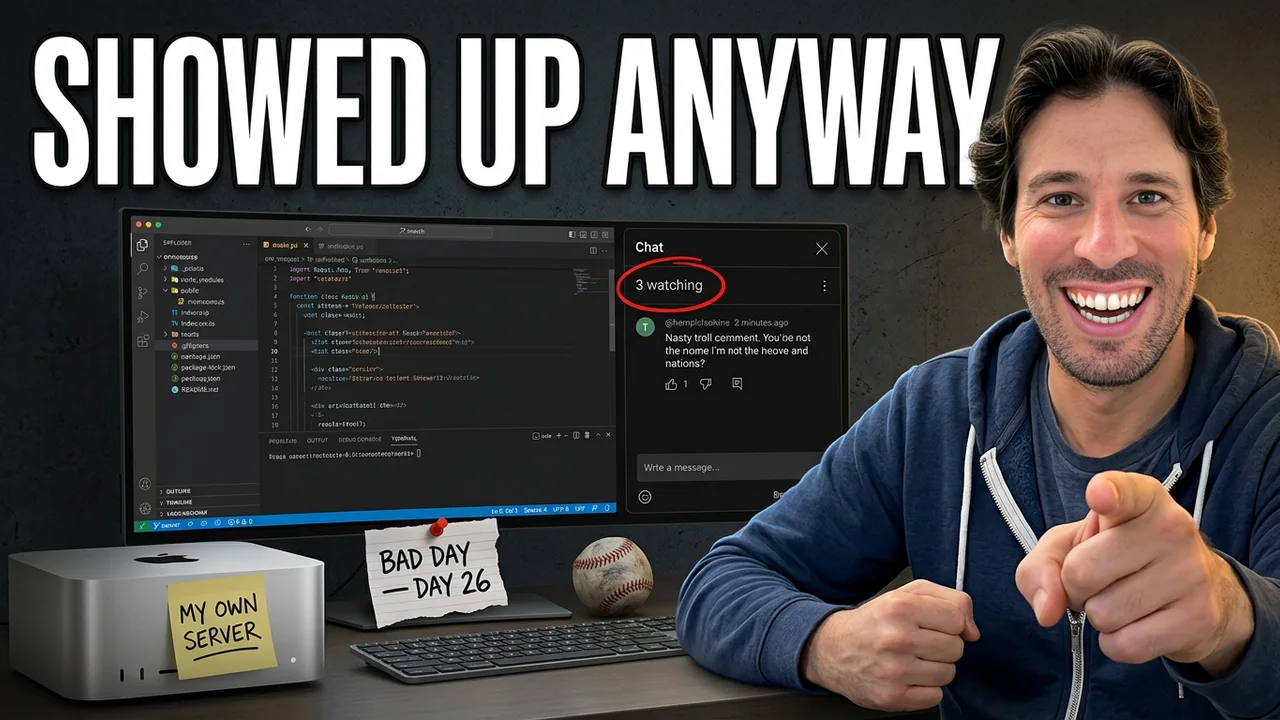

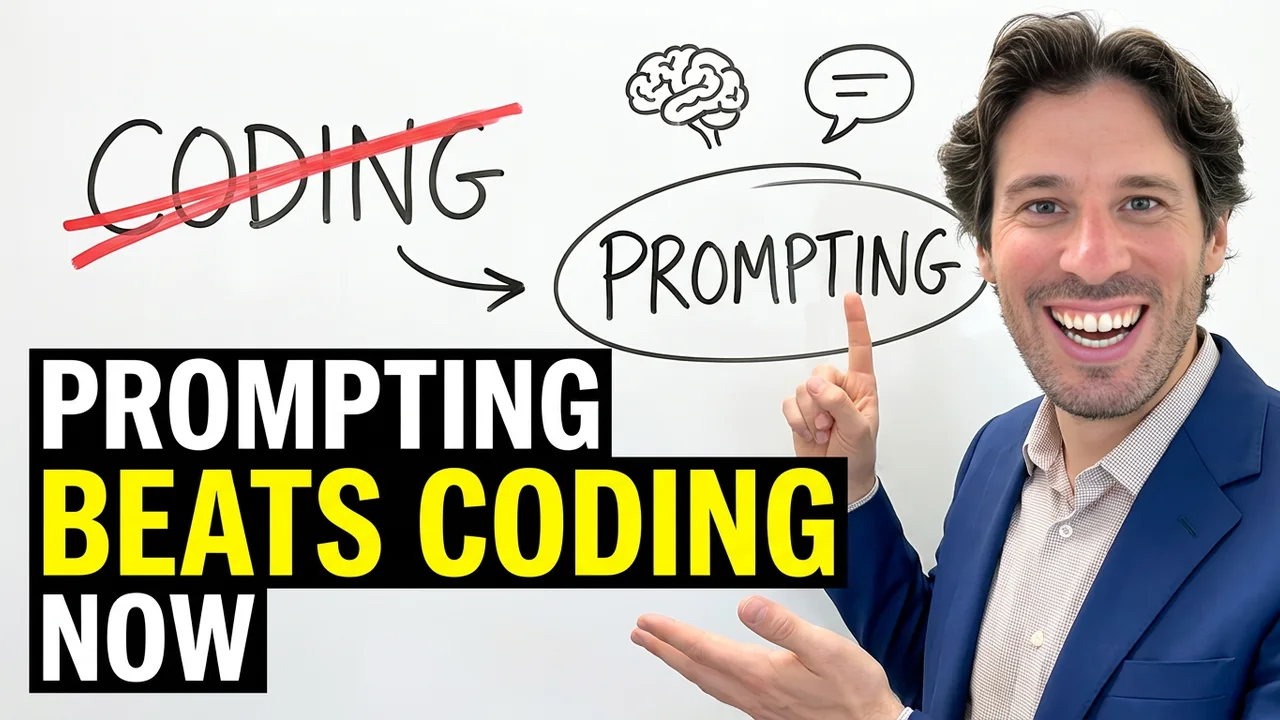
What did I learn from watching Matt Miller build in public for 180 days?
Matt Miller — who builds a product called Bridge Voice — has been live-coding for around 180 days. By his own numbers, he is doing around $220,000 a year and growing. His value is the SaaS product itself. People watch because the product is the content.
My situation is structurally different. I am not building a SaaS product that people can subscribe to independently of me. I am building a community. And as I said on the whiteboard, a community is dead code unless it is used. You cannot demonstrate community value when the community is not yet full.
That comparison clarified something important. Matt's model works because the product exists and generates revenue whether or not he streams that day. My model only works if I am producing content — because I am the product. Copying his format without recognizing that difference was the root of the problem.
What risks does a 180-day live-coding run actually create?
Matt's stream was hit with a distributed denial-of-service attack — 3 million hits per second, shown live on screen. That is the kind of infrastructure problem that arrives when a public live stream grows large enough to attract bad actors. I described my reaction plainly: I am allergic to that as a problem.
Solving that class of problem today — before it happens — is better than scrambling at day 180. The content-first model reduces that surface area. Articles and videos on iCharles.com are served statically. They do not expose a live stream endpoint to the open internet for hours every day.
The "tall poppy syndrome" is real in any public-building context. The bigger the visible signal of growth, the more it attracts people who want to knock it down. A content library scales without the same live attack surface.
How did the 14-video release day actually work?
The 14 videos did not appear from nowhere. A brainstorming session 2 to 3 weeks earlier had established that iCharles.com articles were the real value output — not the live stream itself. The videos were already recorded. The pivot was the decision to release them into the community as a batch and reframe the entire production model around that kind of output.
Here is how the content types map to the funnel:
| Content type | Where it lives | Funnel stage it serves |
|---|---|---|
| YouTube video | YouTube channel | Casual viewer → viewer |
| Article with thumbnail | iCharles.com (public) | Viewer → subscriber |
| Members-only video + article | iCharles community | Subscriber → paying member |
| In-person events (planned) | New York City | Paying member retention |
The thumbnail matters because it makes each piece shareable. The title carries the SEO and AEO weight. The article body is what the crawlers index and what AI models lift into answers.
What did I model iCharles.com's layout on?
I asked an AI to research how CNN and Fox structure their homepages. The answer: featured story, biggest story of the week, latest content, recommended reads. That is a content-density model, not a personal-brand CV model.
Most personal websites lead with a large photo, a name, a credential list, and social links at the bottom. That is a résumé, not a content destination. I want iCharles.com to be a destination — something people return to because there is always something new, not because they are checking my credentials.
The planned personalization layer goes further: visitors will eventually be able to choose articles only, videos only, or both. They will be able to follow specific community members or just my output as admin. That is closer to how a publication works than how a personal site works. Google's helpful content guidelines reward exactly this kind of depth and return-visit intent.
What questions do builders ask when they hit this kind of pivot?
Is it too early to stop a format that is not working? No. I had been live-coding for 38 days when I recognized the format was blocking my actual output. Waiting for a round number — 60 days, 90 days — would have meant 60 or 90 days of compounding the same structural problem. The right time to stop a broken format is when you can name exactly why it is broken.
Can a community be built before the content library exists? Based on what I observed, no — not in a way that generates visible social proof. A community with a dozen members does not look like a community to a new visitor. The content library has to come first. It gives people a reason to join and something to engage with when they arrive.
Does publishing articles still matter when AI is summarizing everything? Yes, and for the opposite reason most people fear. AI models scrape and summarize articles. That means a well-structured article on iCharles.com can surface inside a Perplexity answer or a Schema.org Article structured data-indexed result — reaching people who never visit the site directly. The article is the raw material the AI engines consume.
How do you fund a content-first model before it generates revenue? Carefully. Paid advertising requires social proof — a community that looks active, a product that demonstrably works. Without that, paid spend is wasted. The organic funnel — YouTube to website to community — costs time, not money. That is the only viable path at the early stage.
What is the role of in-person events in a digital community? Events are the highest-trust layer of the funnel. I want to bring vibe coders and builders together in New York City — in the same conference room visible behind the whiteboard. That kind of physical gathering creates the kind of relationship that no amount of article publishing can replicate. It is also the strongest retention mechanism for paying members.
0 Comments
Log in to comment
Not a member yet? Join the community
Pick a meme
KlipyHave a great take?
Drop your email — we'll send a magic link so you can post it. No password.
Not a member of the community? Join today.
Join the community →