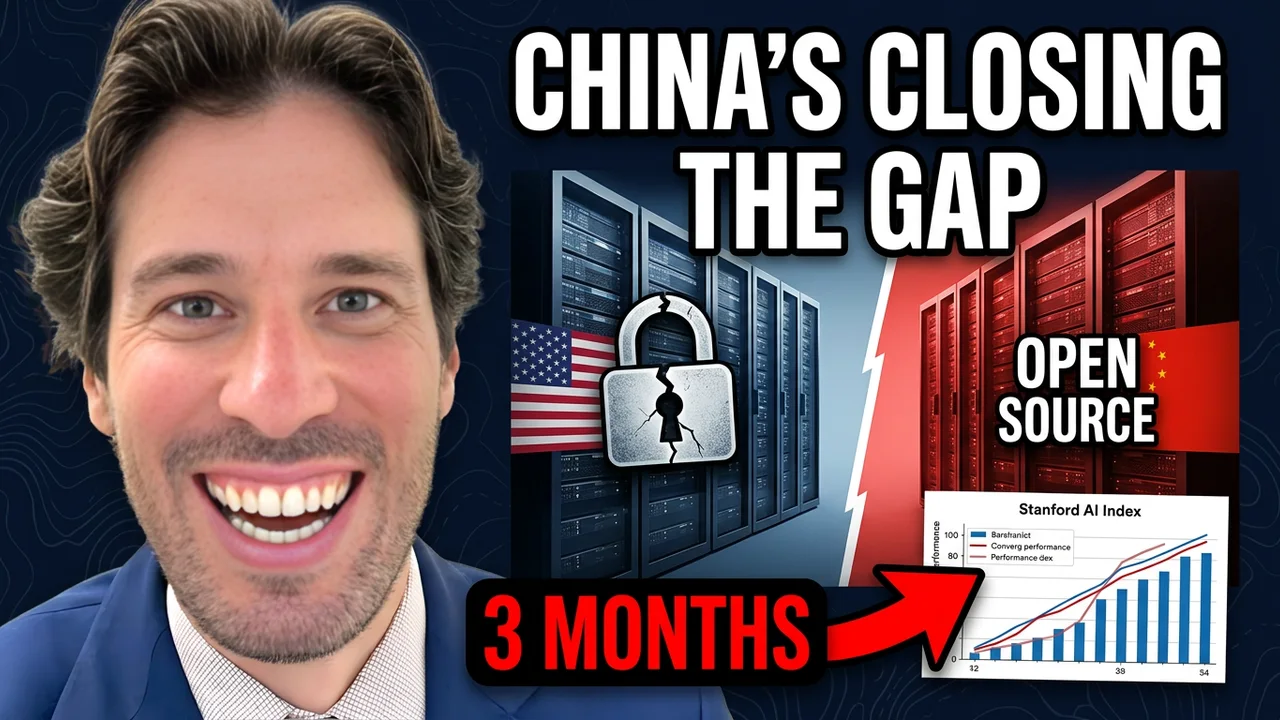
What does China's shrinking AI lag actually mean?
China's open-weight AI models have closed the performance gap with US closed-source systems from roughly 12 months down to about 3 months. That compression is the core signal in a post circulating inside the icharles.com members community this week. The data comes from the Stanford HAI Index and the Epoch AI Index — two of the more rigorous public benchmarks tracking AI capability progress across countries.
The Stanford HAI AI Index annual report and the Epoch AI research on AI progress and compute trends both point to Chinese open-weight models achieving competitive performance in STEM and programming benchmarks. That's not a fringe claim anymore. It's showing up in the primary research.
Why is the US strategy focused on raw compute scaling?
The framing from the members post is sharp: America's approach is raw power through scaling. That means pouring capital into closed-source, multimodal systems built for pure reasoning and synthesis. The bet is that sheer compute and proprietary training pipelines create a moat that open-weight competitors can't cross.
The problem is that moat is shrinking by the quarter. If the lag was 12 months two years ago, then 6 months, then 3 months now, the extrapolation is uncomfortable. At some point the gap becomes noise — close enough that the price difference is the only differentiator that matters to a buyer.
What happened at the US-China AI summit that nobody is talking about?
At [3:45] I said: "I think China just said, no. They just said, no, we're not doing business in AI. We — and they maybe showed them we're as good as you. The ones that we've released is what the public knows about, but not the ones that we haven't released." — That framing reframes the entire summit as a negotiation where China held the stronger hand.
The summit brought a large US delegation — figures from government, industry, and finance — apparently to pitch some form of AI trade normalization. Then Boeing announced a 500-plane purchase on Wednesday. Jensen Huang appeared in a viral video outside a restaurant on Thursday. By Friday, US stock futures fell. Nothing concrete was announced.
You might also like

My read of that sequence: the US came to negotiate access. China declined. And the Boeing announcement may have been a goodwill gesture that China has little incentive to honor long-term — they can reverse-engineer the Dreamliner and the Max and sell to Europe, South America, Africa, and Asia without Boeing in the picture at all.
How does the cost barrier reshape who adopts which model?
This is where the bifurcation gets personal. A high schooler whose parents can't spend $100 a month on Claude Code or Codex is going to use whatever open-weight model runs cheaply or free. That's not a fringe use case — that's the next generation of builders making their first infrastructure decisions.
The financial pressure isn't limited to individuals. Mid-tier companies running high-volume, low-complexity tasks — think CRM birthday email templates, cron jobs, routine data formatting — don't need Claude for any of that. As I put it, you don't even need Haiku for a templated email send. The compute cost is real, and if a Chinese open-weight model handles it at near-zero marginal cost, the CFO will notice.
What will enterprise companies actually do?
The Anthropic enterprise AI platform is built for exactly the segment that won't defect: Fortune 1000 companies where second-tier AI output means second-tier competitive position. Hospitals, law firms, banks, and financial institutions running complex reasoning workflows can't afford to optimize for cost over quality. A wrong inference in a clinical or legal context is not a recoverable error.
My position is that those buyers stay on closed-source. Not because of loyalty — because the risk calculus doesn't change. The enterprise model Anthropic is chasing is the top 1000 companies in the US, and those companies need the best to stay competitive against other companies using the best.
Here's how I think the split shakes out:
| Use case | Likely model choice |
|---|---|
| Complex legal or financial reasoning | Closed-source (Claude, GPT-4 class) |
| Healthcare inference and clinical support | Closed-source |
| Routine CRM tasks, templated emails | Open-weight or Chinese models |
| Mid-tier company general productivity | Hybrid or open-weight |
| Individual builders on tight budgets | Open-weight |
Is there a third path — a compute breakthrough that changes everything?
I think so, though I hold this loosely. My argument is that someone will eventually invent something that sidesteps the raw-compute requirement entirely. Not an incremental chip improvement — a genuine architectural shift that makes the current scaling war look like a local maximum.
The analogy I used on stream: there was reportedly a man who built a car that ran on water. Whether or not that specific story is true, the point is that entrenched lobbies — energy, healthcare, manufacturing, AI infrastructure — all have strong financial incentives to suppress or delay disruptions to the current model. Data centers are hungry for compute, and the companies building them are not neutral observers in this debate.
If that breakthrough comes, it reframes the entire closed-versus-open argument. Enterprise companies could get closed-source quality without the data center overhead. That's the scenario where everyone wins — except the people currently selling compute at scale.
What questions do members have about the China-US AI divide?
Is China's AI really as good as US closed-source models right now? By Charles's account, citing the Stanford HAI Index and Epoch AI Index, Chinese open-weight models are now competitive in STEM and programming benchmarks. The lag has compressed from roughly 12 months to about 3 months. Whether that means parity depends on the task — for complex reasoning, closed-source still leads. For routine STEM and coding tasks, the gap is narrow enough to matter financially.
Will open-source AI replace closed-source for enterprise buyers? Unlikely in the near term for high-stakes domains. Enterprise companies in law, healthcare, banking, and finance need the highest-reliability output available. Adopting a second-tier model to cut costs risks making the company itself second-tier. The financial incentive to stay on closed-source is strong precisely because the competitive cost of a bad inference is so high.
Why did the US-China AI summit appear to produce no agreement? Charles's read is that China declined to negotiate. The sequence — Boeing's 500-plane announcement, Jensen Huang's restaurant appearance, then falling US futures on Friday — suggests the US came with offers and left without a deal. China may have signaled that its unreleased models are already competitive enough that it has no need to open its market to US AI systems.
What is the hybrid AI model Charles expects to emerge? A split where closed-source handles complex, high-stakes reasoning tasks and open-weight or Chinese models handle high-volume, low-complexity work. The example I gave: a CRM birthday email template doesn't need Claude. A hospital diagnostic inference does. Companies will route tasks by risk and complexity, not by vendor loyalty.
Does the geopolitical chip ban change the long-term AI balance? It adds friction but may not be decisive. Charles noted that China claims chip manufacturing capability approaching Nvidia's level. If that claim holds — and it's unverified — then the US export controls on advanced chips become less of a ceiling on Chinese AI development than currently assumed. The chip ban is a real constraint today; whether it remains one in 3 years is the open question.

0 Comments
Log in to comment
Not a member yet? Join the community
Pick a meme
KlipyHave a great take?
Drop your email — we'll send a magic link so you can post it. No password.
Not a member of the community? Join today.
Join the community →