What is vibe coding and why did I start doing it live on YouTube?
Vibe coding is the practice of building software in real time by speaking or typing ideas into an AI coding assistant — no traditional development background required. I am on day 24 of going live on YouTube every day and coding in public with Claude Code. People tune in, drop comments, and sometimes ask to get involved. What started as an experiment has become the most excited I have felt about anything since I got into real estate or started making sales calls back in 2019.
The community I am building is for entrepreneurs, builders, designers, solopreneurs, data architects, and anyone with an idea they have never been able to act on. That is the whole point. The barrier used to be technical skill or budget. Neither of those holds anymore.
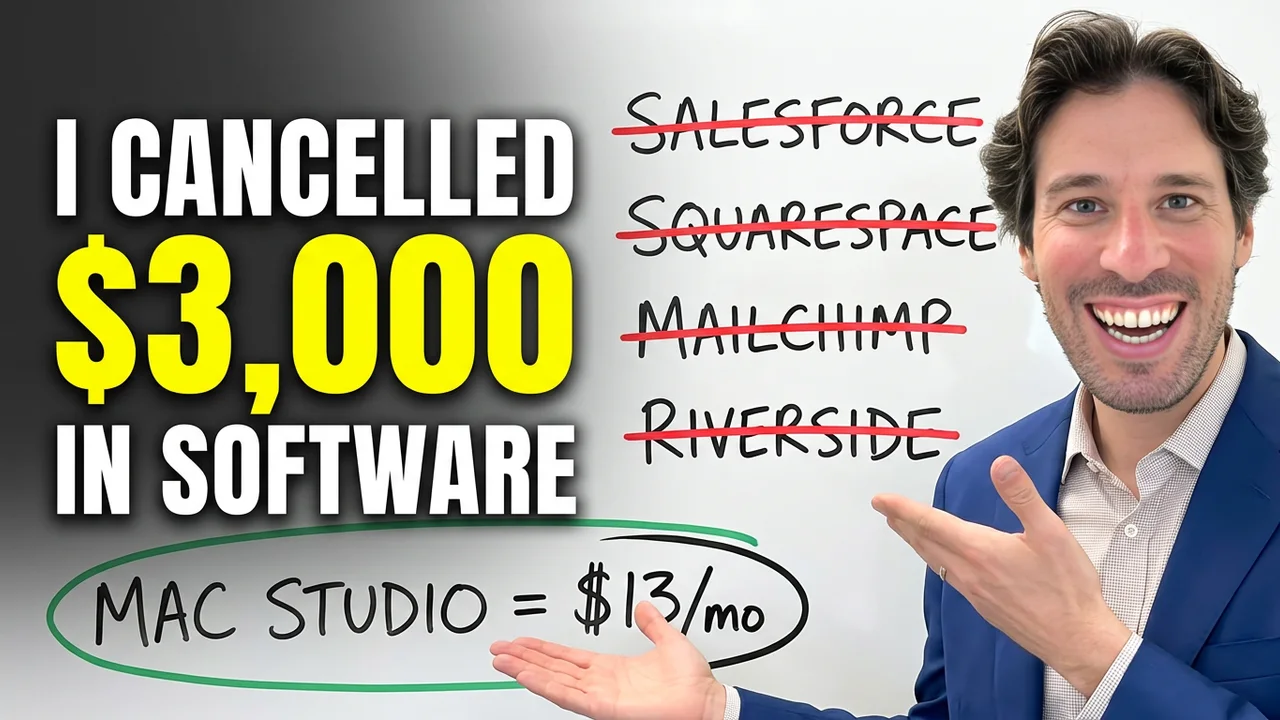
What SaaS subscriptions did I cancel after 24 days of vibe coding?
The numbers are the clearest argument I can make. Here is what I was paying before I started building my own tools, and what happened to each subscription:
| Tool | What I was paying | Status now |
|---|---|---|
| Salesforce CRM | $1,800 | Cancelled — building my own |
| Riverside remote recording platform | $400/year | Cancelled — replaced with local recording |
| Opus Clips AI video clipping tool | $230/year | Cancelled — AI clips my videos automatically |
| MailChimp email marketing | $350/month | Cancelled — building my own distribution |
| Squarespace websites | $50/month + $20 domains | Cancelled — self-hosted |
My total infrastructure spend last month: $13. That $13 covered some background API calls I ran. The Cloudflare DDoS protection and CDN layer I added to harden my server is free on the base plan. I asked Claude how to protect against bots and DDoS attacks. It said: go to Cloudflare. I created an account. Done.
How did I replace Salesforce with something I actually own?
I downloaded every record from Salesforce CRM platform — deals, clients, emails, phone numbers, close dates, locations — into a zip file. My plan is to feed that zip into Claude Code and say: make sense of this, build me a CRM. That is the whole migration plan. No consultant, no data engineer, no six-month project.
At one point during the stream I said: "I built my own Salesforce. Yeah, it's not gonna be as crazy and all these gadgets and then the admin area and the super admin and then all these users and all these permissions. It's not gonna be like that. It's gonna be simplified. It's gonna be easy. Everything's gonna talk to each other." That trade-off is intentional. I do not need enterprise-grade permission hierarchies. I need my client data on my machine, not on a server that is a far more attractive DDoS target than my home setup.
You might also like
Why does running everything on a Mac Studio matter more than it sounds?
The community platform, the CRM, the document storage, the live stream chat, the points and gamification system — all of it lives on my Mac Studio. That is not a limitation. That is the feature. My clients' data is not on someone else's servers. It cannot be caught up in a breach at a company managing millions of records. I am not Salesforce. Nobody is running millions of API calls per second at my machine.
The platform I built includes real-time chat rooms, a bug and feature-request submission area, a full points system where members compete on a leaderboard, and a live stream where people can raise their hand and come on camera. I did not write a line of traditional code to build any of it. I spoke it into existence.
What is the first project a new vibe coder should build?
The pipeline I recommend is simple and it comes directly from what worked for me:
- List every SaaS tool you are currently paying for.
- Pick the one where the core function is straightforward — recording, email lists, a CRM, a booking calendar.
- Open Claude Code and describe what that tool does for you in plain language.
- Ask it to build a minimal version that runs locally.
- Ask it how to harden the security once the core works.
A dentist I heard about on a podcast had always had a product idea in the back of her mind but never acted on it. In one half-day she built an MVP, put it on social media, and started getting customers. That is the proof of concept. The skill floor is lower than almost anyone believes right now.
The rule I keep coming back to: build something you are already spending money on. You do not need a market. You already are the market.
What does the SaaSpocalypse mean for solopreneurs and small businesses?
The SaaSpocalypse is the term being used to describe the wave of SaaS cancellations happening as individuals build their own versions of tools they used to pay for monthly. The dynamic is straightforward. A solo operator who could never justify a $350-per-month email platform can now describe what they need to an AI and have a working version in an afternoon. The addressable market for mid-tier SaaS shrinks every time that happens.
I am not anti-software. I am pro-ownership. Circle.so, which I would have paid $200 a month for as a community platform, is replaced. Skool, which takes a percentage of revenue, is replaced. Notion, Monday.com — the same logic applies to all of them. Why pay a monthly fee for a tool when you can describe the 20% of its features you actually use and have Claude Code build exactly that?
The broader economic shift is real and I am not softening it. Q1 saw massive tech layoffs. Healthcare, law, finance, manufacturing — all of it is in the path of this. The people who get ahead of it are the ones who treat AI as a tool they operate, not a force that operates on them.
What questions do builders ask about getting started with vibe coding?
Is vibe coding only for people who already know how to code? No. I came from 17 years as a real estate broker-owner. I am not a trained developer. The entire premise of vibe coding is that you describe what you want in plain language and the AI handles the implementation. The skill that matters most is being able to articulate what a tool should do — something anyone who has used software has been doing their whole life.
What does a Claude Code subscription cost to start? The entry point is $20 a month for the Sonnet model tier. That is enough to start building real projects. I have mentioned a $100 plan for heavier usage, but for someone just getting started — a 15-year-old, a 75-year-old, anyone new to this — $20 a month is the starting point. The first question to ask it: here is what I am paying for, can you build a simpler version?
How do I handle security if I am running software on my own machine? I asked Claude directly: how do I harden this against bots and DDoS attacks? It walked me through setting up a Cloudflare account. The free tier covers the core protections. The key insight is that a personal server is a far less attractive target than a major SaaS platform. I am not managing millions of user records. The risk profile is genuinely different.
Can I build a community platform from scratch without hiring a developer? I built mine — with live chat, a points and gamification system, a bug submission area, member profiles, and a live stream with hand-raise functionality — by describing each feature to Claude Code during live sessions. The first 50 members of my community are free while I get it running. The platform lives on my Mac Studio and costs me nothing in monthly hosting fees.
What is the single best first project for a non-technical solopreneur? Build a website. That is the answer I keep landing on. It is the most universally useful starting point, it teaches you the feedback loop of describing what you want and iterating on the output, and it immediately eliminates a Squarespace or similar subscription. From there, the next project almost always reveals itself — usually whatever tool you are still paying for that the website made you think about.

0 Comments
Log in to comment
Not a member yet? Join the community
Pick a meme
KlipyHave a great take?
Drop your email — we'll send a magic link so you can post it. No password.
Not a member of the community? Join today.
Join the community →