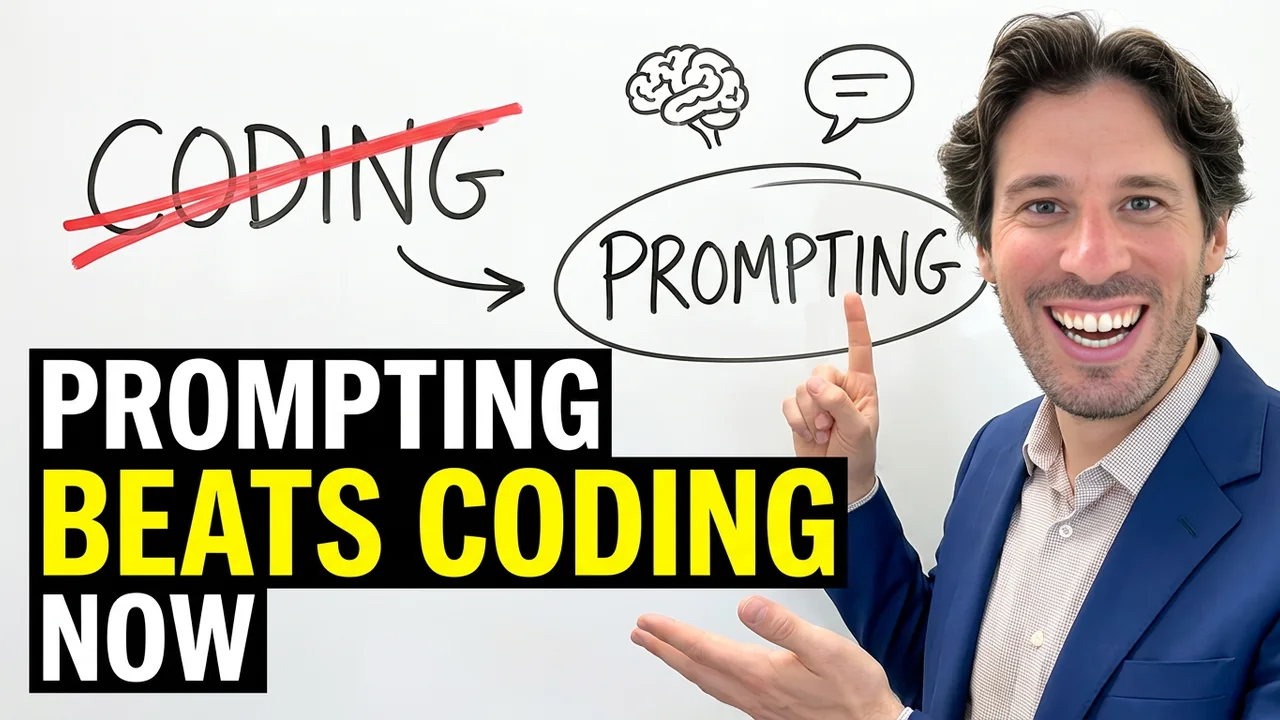
Why does prompting skill matter more than coding skill right now?
Whoever prompts better wins. That is the thesis I keep returning to after three weeks of building, debugging, and watching AI rewrite the economics of software. By Charles's own account on stream, as much as 75% of Google's code may now be AI-written — a figure he openly doubted on camera ("I can't believe it's even 75%"); widely reported public estimates run lower, closer to a quarter of new code. The head of Claude Code has also said publicly he hasn't written a line of code in a year. The skill gap that used to separate technical founders from everyone else is closing fast. What's opening in its place is a prompting gap.
Vague input produces vague output. When I typed "make it better" into a session recently, the model had no idea what I meant. Better-looking? Faster? More color? More responsive on mobile? The prompt was useless because I hadn't done the thinking first. That moment clarified everything for me.
What does "prompting better" actually mean in practice?
It means specificity at every layer — design, security, performance, and user needs. Before I write a single prompt for a new feature, I run a brainstorming session with the AI first. I describe the client, the audience, the pain points, and the desired outcome. Only then do I ask it to build anything.
I did exactly that this morning. I asked Claude: in the eyes of the members in my community, what do you think they want right now — give me the 5 top priorities. It came back with 5 ideas that were genuinely useful. One of them was a to-do list for people vibe coding alongside me. That came from a prompt, not from a planning meeting or a product manager.
At [0:52] I said: "when you specifically say after you build a brainstorming session with AI around a new feature or a new build or new website… what are the most important things within MailChimp or Squarespace that's needed?" — the point being that even scoping a client project is now a prompting exercise, not a requirements document.
How does AEO change the way I structure written content?
AEO (Answer Engine Optimization{target="_blank" rel="noopener noreferrer"}) is the practice of structuring content so that AI answer engines — Perplexity, ChatGPT Search, Google AI Overviews — can extract and cite it directly. It differs from traditional SEO in one critical way: placement of the most important information.
Traditional SEO taught writers to hook a human reader in the opening paragraph and build toward the conclusion. AEO inverts that. AI scrapers don't read the full article — they read the top. So I put all the takeaways at the top, then the supporting detail below, with internal anchor links so the engine can follow the structure.
You might also like
I built a custom AI tool{target="_blank" rel="noopener noreferrer"} that reviews every article I publish against these standards — checking whether it meets what SEMrush SEO and content audit platform measures for Google crawlability and what Perplexity and Claude expect when someone asks a real question. The tool runs the article through those benchmarks before anything goes live. That entire tool was built through prompting.
Are soft skills{target="_blank" rel="noopener noreferrer"} now the real hard skills for builders?
I was listening to the Moonshots podcast and a line stopped me: soft skills are becoming the new hard skills. That framing landed differently once I connected it to prompting.
Steve Jobs could explain why the iPhone was necessary before a single line of code existed. He articulated the pain points, the desires, the emotional need. That is exactly what a good prompt does. You tell the AI what you want to build, who it's for, and why it matters. You bring the vision. The model brings the execution.
The builders who are winning right now aren't the ones who can write the most elegant function. They're the ones who can see the product clearly before it exists and describe it precisely enough that the AI can build it. Visualization and idea articulation — classically "soft" — are now the bottleneck.
What can precise prompting actually build — and how fast?
Here is a concrete comparison of what I built through prompting alone versus what the same work would have required before AI:
| What I built | How it was built |
|---|---|
| AEO/SEO article review tool | Prompted Claude with SEMrush standards and article structure rules |
| Full security suite for the members community | Deep research prompt after detecting a vulnerability in visitor logs |
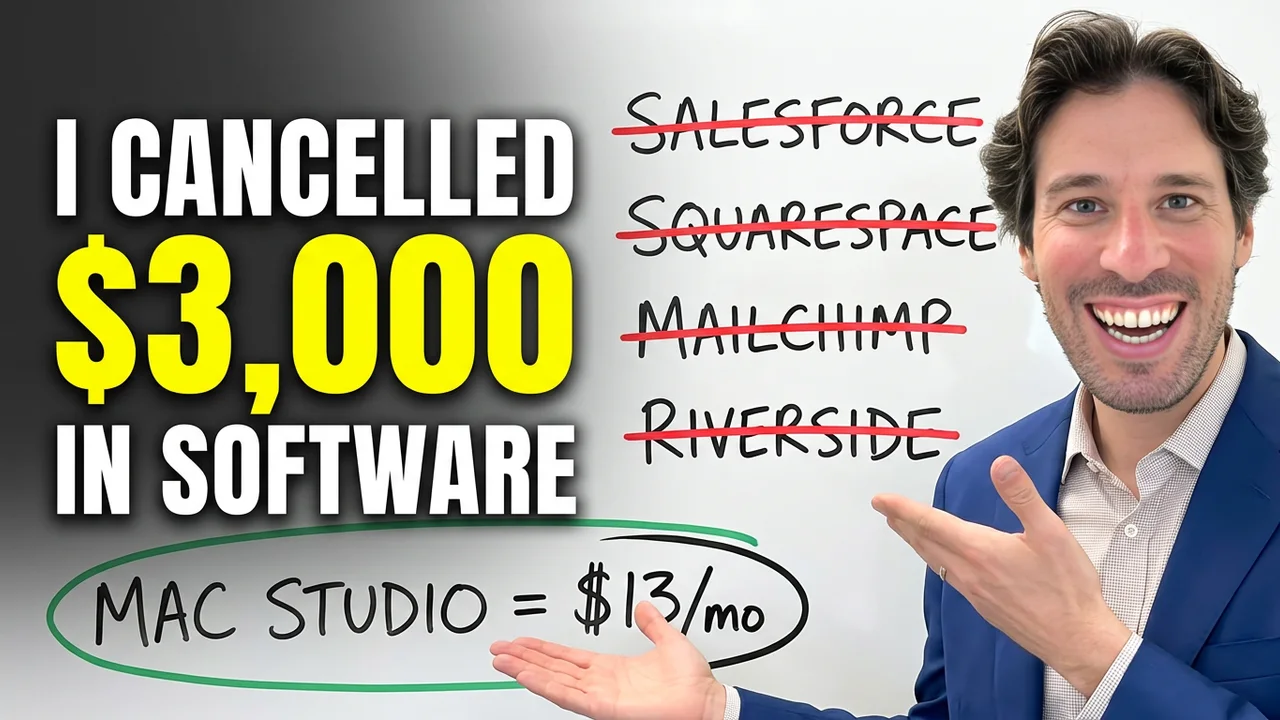
| Custom email inbox using Resend API keys | Replaced MailChimp by prompting the integration from scratch |
| Member community feature roadmap | Single Claude prompt: "what do my members want most right now?" |
The security build is worth dwelling on. I had a bug where someone was able to exploit a gap in the members' area. I had a blueprint of every visitor and their interaction patterns. I fed that context into a deep research prompt — high benchmarks, elite coder persona, full vulnerability analysis — and a complete security suite came out the other side. All through prompting. The Cloudflare developer security documentation gave me the mental model for what questions to ask.
Why does owning your own stack matter more now than it did before AI?
Before AI, a solo founder or small team built their content business on other people's infrastructure. Squarespace for the website. MailChimp for email. Cloudflare for protection. Those tools talked to each other through API calls, but none of it was truly owned. The product lived on someone else's server.
Now I host my own site. I run my own email through the Resend transactional email API instead of paying MailChimp for a newsletter stack I only use 20% of. I prompted that entire migration. The ideas were mine. The execution was AI-assisted. The infrastructure is mine.
This is what AI has actually unlocked for the entrepreneur — not just faster coding, but genuine ownership. The thing that always sat just out of reach because it required a team, a budget, and months of runway can now be built in a focused session with Claude and a clear prompt.
What questions do builders ask most about prompting and AI-assisted development?
Is prompting a skill you can actually get better at, or is it just trial and error? Prompting is a learnable skill. The fastest way I've found to improve is to study how the best already do it. I look at how Cloudflare describes its own security architecture, then I use that framing to prompt my own security layer. Borrowing the vocabulary of experts — and feeding it back into the model — produces dramatically better output than starting from scratch.
What is the difference between a vague prompt and a specific one? A vague prompt gives the AI no constraints: "make it better" could mean anything. A specific prompt names the audience, the goal, the platform, the failure mode being fixed, and the standard to hit. "Make this mobile-first, with playback speed controls on video, and two-factor authentication on login" is a prompt. "Make it better" is noise.
Does the head of Claude Code really not write code anymore? That is what was said publicly — he hasn't written code in a year. He may review it, but the authoring is AI-driven. The Anthropic Claude Code documentation reflects how far that tooling has matured. If the person building the coding tool isn't writing code, the argument that coding is the core skill is hard to sustain.
How is AI's impact on software comparable to the interstate highway system? The interstate highway system of the 1950s and 1960s didn't just make driving faster — it made any destination reachable. AI has done the same for ideas. Any app, any website, any feature is now buildable by someone with a clear vision and a good prompt. The constraint shifted from "can I build this?" to "can I describe this precisely enough?"
What should I prompt when I don't know what to build next? Ask the AI to take the perspective of your users. I asked Claude this morning to tell me what my community members most likely want right now, based on everything it could see about the product. It returned 5 prioritized ideas in under a minute. That is a legitimate product research session. The output is only as good as the context you give it — so describe your audience and your current build before you ask.

0 Comments
Log in to comment
Not a member yet? Join the community
Pick a meme
KlipyHave a great take?
Drop your email — we'll send a magic link so you can post it. No password.
Not a member of the community? Join today.
Join the community →