
Boris Cherny, Head of Claude Code at Anthropic, described a structural transition in software engineering: "I don't prompt Claude anymore. I have loops running that prompt Claude and figuring out what to do. My job is to write loops" (Gong, 2026). Technology executives observe this shift across the industry. Engineers design the programmatic pipelines that govern autonomous artificial intelligence agents, replacing manual text prompts.
The Architecture of the Loop
The design of modern AI tools depends on state management and continuous execution cycles. In their architectural analysis of agent systems, researchers document that tools like Claude Code function via a structured while-loop (Liu, 2026). Engineers configure this loop to call the language model, execute system commands, and evaluate data until the task achieves the target outcome.
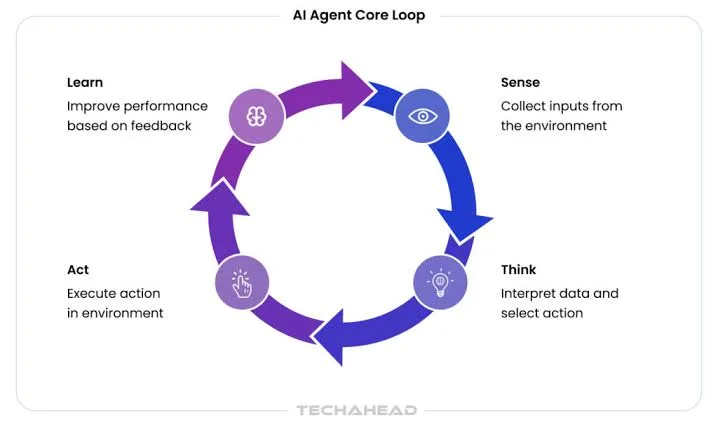 The iterative cycle of an autonomous AI agent loop. Source: TechAhead
Engineers break down agent operations into four stages: sensing environment inputs, selecting actions via a reasoning model, executing commands, and learning from feedback. The human developer acts as the architect of this system. You construct the safety boundaries, context management filters, and tool-access permissions that keep the model focused on the objective, leaving the management of individual prompts to the automated system.
You might also like



The Reality of Intent-Centric Development
Software researchers define this model as intent-centric engineering (De La Cruz, 2026). In this workflow, a developer specifies the desired outcomes, resource parameters, and safety policies (De La Cruz, 2026). The engineer configures the framework to test and refactor candidate implementations until the code satisfies the original constraints.
| Aspect | Legacy Approach | Loop-Based Approach |
|---|---|---|
| Primary Task | Code authorship and manual prompting | Architecture design and loop engineering |
| Execution | Step-by-step human intervention | Continuous autonomous execution cycles |
| Verification | Manual code review and ad-hoc testing | Automated feedback pipelines and policy gates |
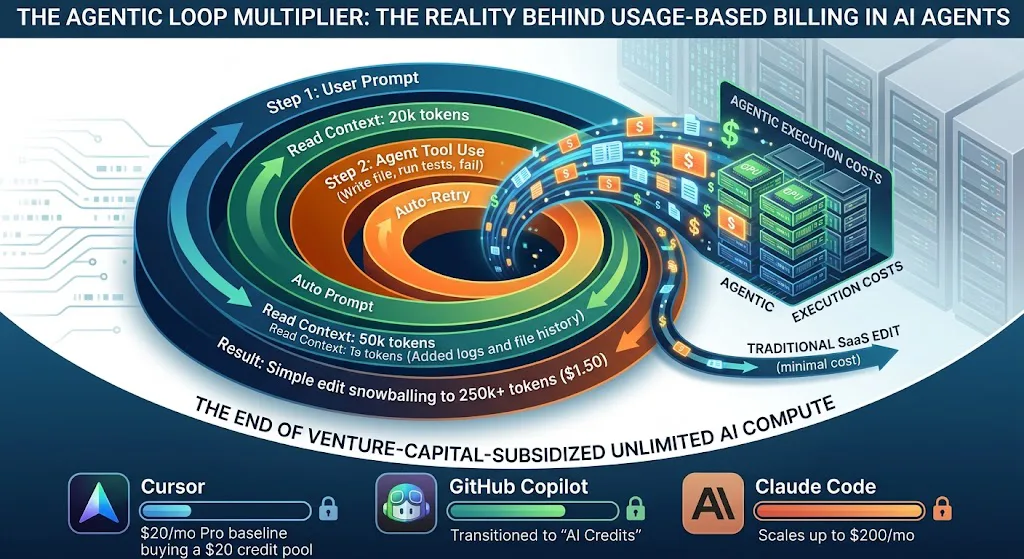
This model limits the time engineers spend on repetitive syntax. Google and Anthropic report that their engineers generate a substantial portion of production code using these automated tools (Thangarajah, 2026). Automation introduces technical challenges. Language models operate on statistical probabilities. When an agent fails an initial task, the execution enters a repetitive error cycle unless an independent validation step breaks the sequence.
Structural Risks and the Need for Verification
Agentic loops alter the balance of software development. While loops generate initial output, teams can overlook systemic debt. Rohde (2026) warns that automated code generation can mask a decline in core engineering expertise if organizations substitute human judgment with model outputs.
Apprenticeship pipelines, peer review processes, and deep domain knowledge remain vital. Software engineers spend time reviewing, correcting, and validating agentic outputs to maintain architectural integrity (De La Cruz, 2026). Developers shift their focus from writing text to establishing strict governance. You write the loops, but you must design the verification gates that ensure security, performance, and correctness.
References
De La Cruz, E. (2026). A Reflexive Thematic Analysis of Generative AI, Agentic Systems, and Engineering Accountability. arXiv. https://arxiv.org/abs/2605.11027
Gong, H. (2026). AI Agents in Financial Markets: Architecture, Applications, and Systemic Implications. MDPI. https://www.mdpi.com/2674-1032/5/2/34
Liu, J. (2026). Dive into Claude Code: The Design Space of Today's and Future AI Agent Systems. arXiv. https://arxiv.org/abs/2604.14228
Rohde, W. (2026). Short-Term Gain, Long-Term Fragility: AI Labor Substitution and the Erosion of Sustainable Capability. arXiv. https://arxiv.org/abs/2605.27399
Thangarajah, K. (2026). SynConfRoute: Syntax-Aware Routing for Efficient Code Completion with Small CodeLLMs. arXiv. https://arxiv.org/abs/2605.04894





0 Comments
Log in to comment
Not a member yet? Join the community
Pick a meme
KlipyHave a great take?
Drop your email — we'll send a magic link so you can post it. No password.
Not a member of the community? Join today.
Join the community →