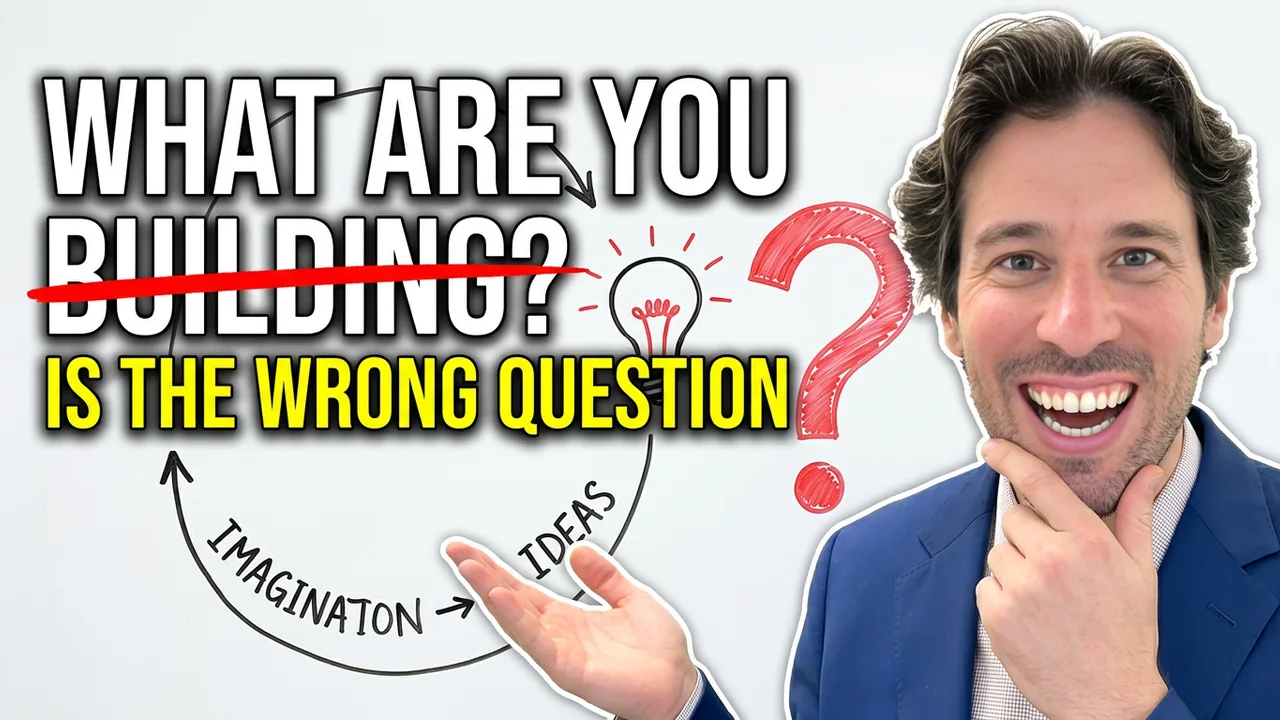
Why does refusing to answer "what are you building" actually work?
Withholding the answer forces the other person to imagine — and imagination is where every real idea begins. When someone walks into my community chat and types "what are you building," the worst thing I can do is explain it. The moment I define it, I've ended their curiosity. I've handed them a label instead of an experience. There are currently 10,000 subscribers on my channel and a growing members community, and none of that means anything to someone who hasn't wondered about it first.
The difference is small but decisive. "That's a fan" tells you nothing you'll remember. "This cools you down when it gets really hot" makes you feel something. One closes the loop. The other opens it.
What did watching Matt Miller's MRR plateau teach me about my own next 180 days?
At [1:47] I said: "In 180 days, not only do I know I'm going to be there, maybe not at his MRR, but I'm gonna be there in my community and I don't wanna face that problem" — and that single thought sent me straight into a planning session I hadn't scheduled.
Matt Miller runs BridgeVoice, a SaaS product built around vibe coding. He talked openly about his monthly recurring revenue stagnating — and then reversing. He picked up roughly $17,000 in new memberships after that low point. I'm not in his business, and I can't take away his flowers. But I put myself in his shoes. That's the move. You see someone else hit a wall, and instead of scrolling past it, you ask: in 180 days, is that wall mine?
That question pulled me into a brainstorming session with a whiteboard. It produced 2 concrete pivots I hadn't been planning to make.
How does first-principles thinking connect to imagination and ideas?
First-principles reasoning is the practice of stripping a problem down to its fundamental truths and rebuilding from there, rather than reasoning by analogy from what already exists. Elon Musk applied it to electric vehicles: batteries overheat, batteries are heavy, a combustion engine has hundreds of moving parts. So remove the engine, reduce the parts count, redistribute the weight, and the car becomes lighter, roomier, and simpler. That's first-principles reasoning in engineering and entrepreneurship applied at full scale.
The same loop runs through ideas and imagination. You can't reach a genuinely new answer if you start by copying the shape of the old one. You have to go back to silence, admit you don't know, and let the question breathe.
You might also like

Musk failed a lot, for years. That's not incidental — it's structural. Humility isn't a soft skill here. It's the prerequisite for staying in the loop long enough to get to the good ideas.
Why are high-quality questions more powerful than confident statements?
Tony Robbins put it plainly: the salesperson who asks the most high-quality questions wins. When I first heard that, I pushed back. I thought the closer was the one making bold statements, projecting certainty. I was wrong.
Curious people ask questions. They sit in silence. They listen. When I was working in real estate, I had a fixed set of questions I asked every homeowner before a listing went live: Is there a timeline you're looking to sell by? Is there a price range you want to stay within? Are there other decision-makers I should be talking to? Those questions weren't filler. They were the whole job. The Harvard Business Review research on high-quality questions in sales confirms what I experienced in practice — asking well beats telling confidently, every time.
High-quality questions changed my life. That's not rhetorical. My thinking is structurally different because I learned to ask before I assert.
What pivots did curiosity and planning actually produce for iCharles?
The planning session triggered by Matt Miller's MRR story produced 2 specific pivots I can name.
| Pivot | From | To |
|---|---|---|
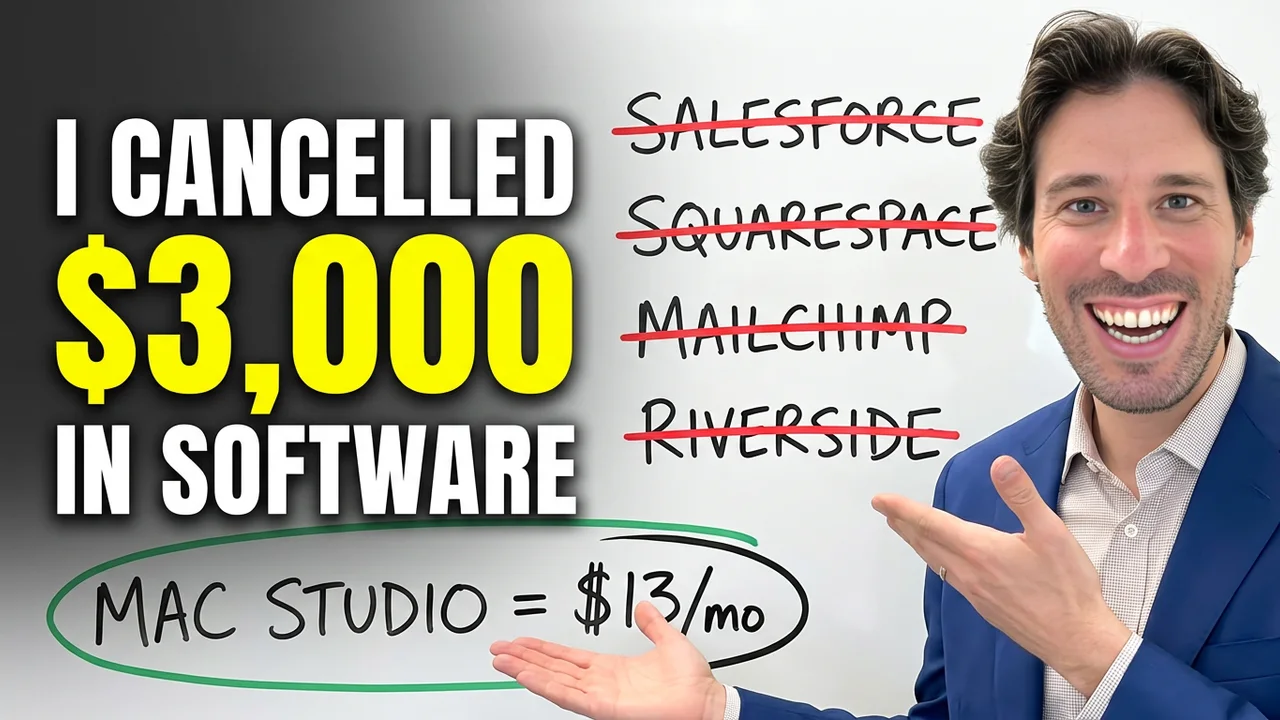
| Video hosting | Storing videos locally on my computer | Hosting on Cloudflare R2 object storage for video hosting |
| Community value model | Community alone as the core product | Community plus a full YouTube content library on both iCharles and my personal channel |
Neither of these was on my roadmap before I sat with the question. The first came from thinking about scale — local storage doesn't hold when the content library grows. The second came from realizing that the videos aren't supplementary to the community. They are the community, combined.
Both pivots came from the same sequence: observe a problem in someone else's situation, imagine it as my own, sit in silence, ask high-quality questions, plan.
Is humility actually a strategic input, or just a mindset cliché?
It's a strategic input. Here's why. If I walk into a situation already knowing what something is, I stop looking. I stop asking. The curiosity loop closes. And closed loops don't produce new ideas — they reproduce old ones.
When I say I don't know exactly what I'm building, I mean it literally. I don't know if every person who asks "what are you building" is the right fit for this community. That's not gatekeeping. That's honesty. The product is still forming. The imagination is still running. The ideas are still coming. Announcing a fixed answer would be lying about where I actually am.
Humility keeps the loop open. Willingness to fail keeps it honest. Silence gives it room to run.
What do builders in public most want to know about this approach?
Does staying vague about "what you're building" actually hurt growth? Not in my experience. Vagueness that comes from genuine curiosity reads differently than vagueness from confusion. When someone sees a product and wonders what it is, that wonder is engagement. I'd rather have 10 people genuinely curious than 100 who were told a pitch and moved on. The 10,000 subscribers on my channel grew while I was still figuring it out.
How long should a 180-day planning session actually take? I don't treat it as a single meeting. It starts with a brainstorming session — whiteboard, no agenda, just questions. Then it becomes a planning document. The 180-day frame isn't a deadline. It's a forcing function. It makes the abstract problem — "what if I stagnate like Matt Miller did?" — concrete enough to plan against.
What makes a question "high quality" in this context? A high-quality question is specific, honest, and uncomfortable. "Is there a timeline you're looking to sell by?" is high quality because it forces a real answer. "What do you think of the market?" is low quality because it invites a non-answer. In my own planning, high-quality questions sound like: "In 180 days, what problem will I definitely have that I'm ignoring right now?"
Should I explain my product to everyone who asks about it? I don't — and the reason is practical, not philosophical. If someone asks "what are you building" before they've engaged with what's already visible, they're skipping the imagination step. That step matters. It's where their genuine interest either forms or doesn't. Explaining too early short-circuits that. Let them wonder first. Then answer the questions that come from real curiosity.
How does this connect to first-principles thinking day to day? First principles isn't a framework you apply once. It's a habit of asking "why does this have to be this way?" every time you hit a constraint. I applied it to video hosting — why does the video have to live on my machine? I applied it to community value — why does the community have to be the only product? Each time, the answer changed what I built next. The loop is: observe, imagine, question, plan, pivot.

0 Comments
Log in to comment
Not a member yet? Join the community
Pick a meme
KlipyHave a great take?
Drop your email — we'll send a magic link so you can post it. No password.
Not a member of the community? Join today.
Join the community →