What is the real problem when you make zero money from content?
The problem is not the content itself — it's trust. I'm 17 years into running a broker owner business in New York City, and I'm making zero dollars from content creation right now. That's the starting point. Every brainstorming session I run begins with the same discipline: name the problem honestly before you reach for solutions.
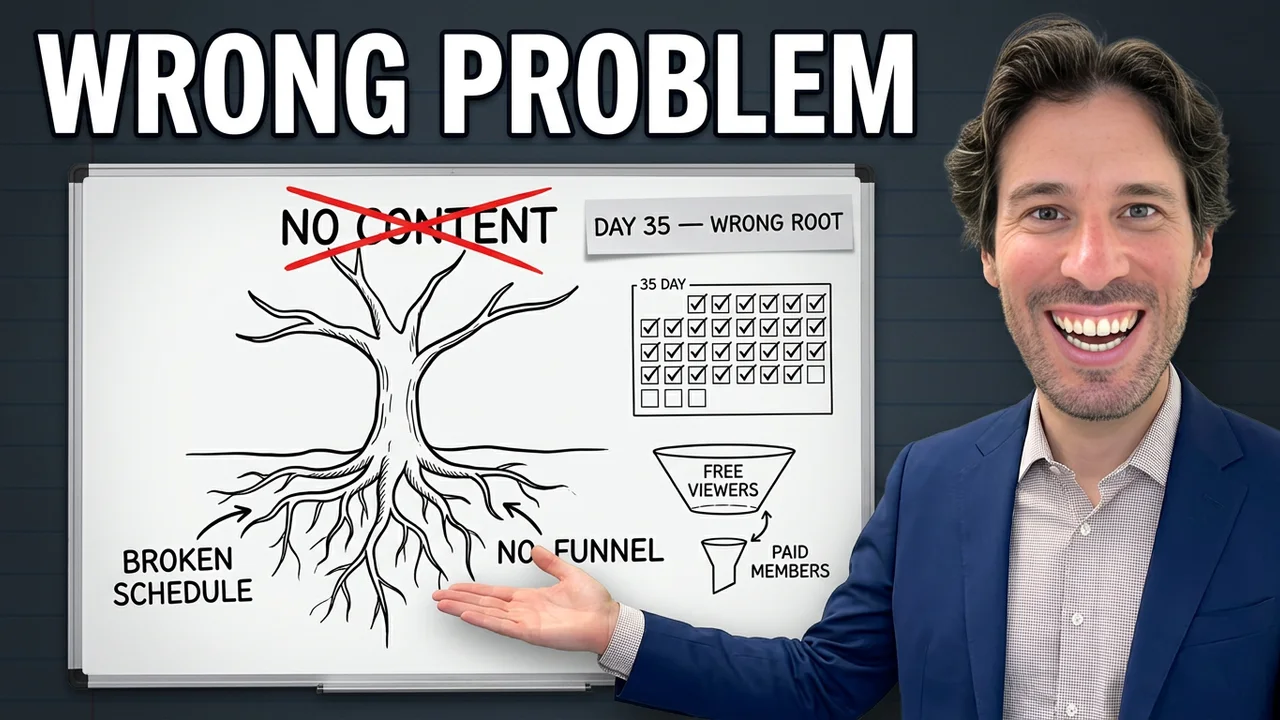
The problem, stated plainly, is that I provide no measurable value yet to the platforms that would send me browsers. No browsers means no viewers. No viewers means no subscribers. No subscribers means no paying customers. The whole funnel collapses at the first gate.
At [0:00] I said: "My problem, as any brainstorming session, is okay, what is the problem? The problem is I'm making zero money and I have to make money" — naming the constraint this bluntly is what keeps a brainstorm from drifting into wishful thinking.
What does the browser-to-paid funnel actually look like?
The funnel has 4 stages. Each stage requires a different kind of value delivery, and each transition is a trust test.
- Browser — a flyby visitor who found me through YouTube, Google, or an AI model. They give me only seconds.
- Viewer — someone who decided the thumbnail and title were worth a click. They give me minutes, maybe once.
- Subscriber — a regular viewer who returns 3 or 4 times a week. They give me consistent attention.
- Paid — someone who exchanges both time and money. That's the highest-trust relationship in the funnel.
The browser visits maybe once. The viewer comes back 1 to 2 times a week. The subscriber is 3 to 4 times a week. The paid customer is the end of the line — and right now, I have almost no one at that stage.
Why does trust matter more than subscriber count?
I have 10,000 YouTube subscribers. That number sounds decent. It means almost nothing right now, because subscribers without trust don't convert — and the platforms themselves won't amplify content they don't trust.
Trust, in this context, means two things. First, the platform trusts that my content satisfies the viewer's intent. Second, the viewer trusts that clicking my thumbnail will actually give them what the title promised. Both have to be true simultaneously. If either breaks, the bounce rate climbs, the algorithm pulls back, and the funnel stalls.
I looked at my Cloudflare analytics and found 240,000 crawlers hitting the site during a period when I had published almost no content. Per Cloudflare's explanation of how web crawlers work, crawlers index what exists — and what existed was essentially nothing worth surfacing. Traffic without content is just noise.
How did three niche pivots put my YouTube channel in purgatory?
YouTube's algorithm builds a model of what your channel is about and who to serve it to. I gave it 3 contradictory signals over time.
You might also like

| Phase | Niche | Algorithm's Model of Me |
|---|---|---|
| Phase 1 | Personal development | Serve to personal development audience |
| Phase 2 | Faith-based content | Rebuild model for faith audience |
| Phase 3 | Vibe coding | No clear match — algorithm holds back |
Each pivot reset the trust the algorithm had built. Now I'm in what I called "purgatory" — the algorithm doesn't know which audience to serve me to, so it serves me to almost no one. The click-through rate on my videos is terrible as a result. The whole system — thumbnails, descriptions, timestamps, titles — needs to be rebuilt from scratch.
What is the thumbnail-title relationship and why was I getting it wrong?
The thumbnail-title relationship is the paired creative unit that drives a viewer's decision to click — the thumbnail creates curiosity, the title sharpens it, and the viewer bounces between the two before deciding.
I had been treating the thumbnail and the title as 2 independent creative decisions. I was prompting AI to generate a thumbnail separately from the title. That's wrong. A viewer's actual behavior is: thumbnail → title → thumbnail. They cycle between the 2 until the combination earns a click or they scroll past.
Mr. Beast is the clearest example of this done right. The image shows something visually extreme. The title explains the stakes. The viewer looks back at the image and the combination closes the sale. There's a locked relationship between the visual and the words — neither works without the other.
My current prompts produce chaotic thumbnails. The background is cluttered. The text layer competes with the image. There's no variation across videos. And critically, there's no designed relationship between what the thumbnail shows and what the title says.
How am I fixing the thumbnail and title system right now?
The new system I landed on mid-session: 4 thumbnail prompts per video, each paired to a matching title, then scored before anything gets uploaded.
A thumbnail has 3 layers: the person in the foreground, the text in the middle layer, and the background. I had been generating 1 thumbnail with no variation in the text or background layers. That's not enough options to find a strong thumbnail-title pair.
The SRT file — the transcription with timestamps — runs through AI to generate the title and description. That part of the pipeline works. What wasn't working was that the thumbnail generation was a completely separate process with no connection to the title output. Now those 2 processes need to feed each other.
I've been testing VidIQ for thumbnail scoring. I tried Nano Banana and Gemini for the same task — neither produced results I was happy with. VidIQ's thumbnail tool gave more usable output. The YouTube official guide to thumbnails and click-through rate confirms that custom thumbnails are one of the highest-leverage variables in whether a video gets clicked.
What is AEO and how does it fit alongside SEO?
AEO (Answer Engine Optimization) is the practice of structuring content so that AI models — Perplexity, ChatGPT, Claude, Gemini — surface it as a direct answer to a user's query, rather than just ranking it in a list of links.
SEO targets Google's traditional search index. AEO targets the AI layer that sits above it. Both matter because the browser stage of my funnel can come from either source. Someone asking "what are the best sneakers for a marathon" might go to Google or directly to an AI model. I need to be findable in both places.
Google is currently disrupting its own search product by pushing users toward Gemini first. That's a company cannibalizing a business it spent hundreds of billions of dollars building — because it has no choice. The Google Search Central SEO starter guide still applies to the crawler layer, but AEO is the new surface I have to build for simultaneously.
Right now my AEO trust score is, by my own honest assessment, zero. I haven't published enough structured content for any AI model to treat me as a reliable source.
What questions do builders ask about content trust and funnel strategy?
What does a bounce rate actually signal to the YouTube algorithm? A high bounce rate tells the algorithm that viewers clicked but left immediately — meaning the thumbnail-title pair overpromised or the content underdelivered. YouTube uses viewer behavior, not just clicks, to decide whether to keep distributing a video. A low bounce rate signals that the content satisfied intent, which builds algorithmic trust over time.
Why does niche consistency matter more than posting frequency? The algorithm builds an audience model based on topic signals across your entire channel history. Posting frequently in 3 different niches confuses that model — the algorithm can't match your content to a stable audience. Consistency in topic gives the algorithm a clear signal about who to serve your videos to, which is what drives organic reach.
How do AI crawlers differ from Google's search crawlers? Google's crawlers index text and code structure to rank pages in search results. AI model crawlers — used by Perplexity, Claude, and others — are looking for content they can cite as a direct answer. The trust signals are similar (accuracy, structure, authority) but the output is different: a ranked link versus a quoted answer. Both require the same underlying content quality.
Is 10,000 YouTube subscribers enough to start monetizing? By Charles's account, 10,000 subscribers is not sufficient on its own — the trust score matters more than the raw number. A channel with low click-through rates, high bounce rates, and no niche consistency won't convert subscribers to paid customers regardless of count. The funnel has to work at every stage, and trust is what moves people through it.
What is the difference between the crawler layer and the interface layer in SEO? The crawler layer is the code structure of a site — how pages are linked, how content is tagged, how the site signals its topic to bots. The interface layer is what a human reader sees: is it mobile responsive, is it clear, does it answer the question? Both layers need to be built correctly. A beautiful interface with a broken crawler layer won't rank. A well-structured crawler layer with a poor interface will lose the visitor once they arrive.
0 Comments
Log in to comment
Not a member yet? Join the community
Pick a meme
KlipyHave a great take?
Drop your email — we'll send a magic link so you can post it. No password.
Not a member of the community? Join today.
Join the community →