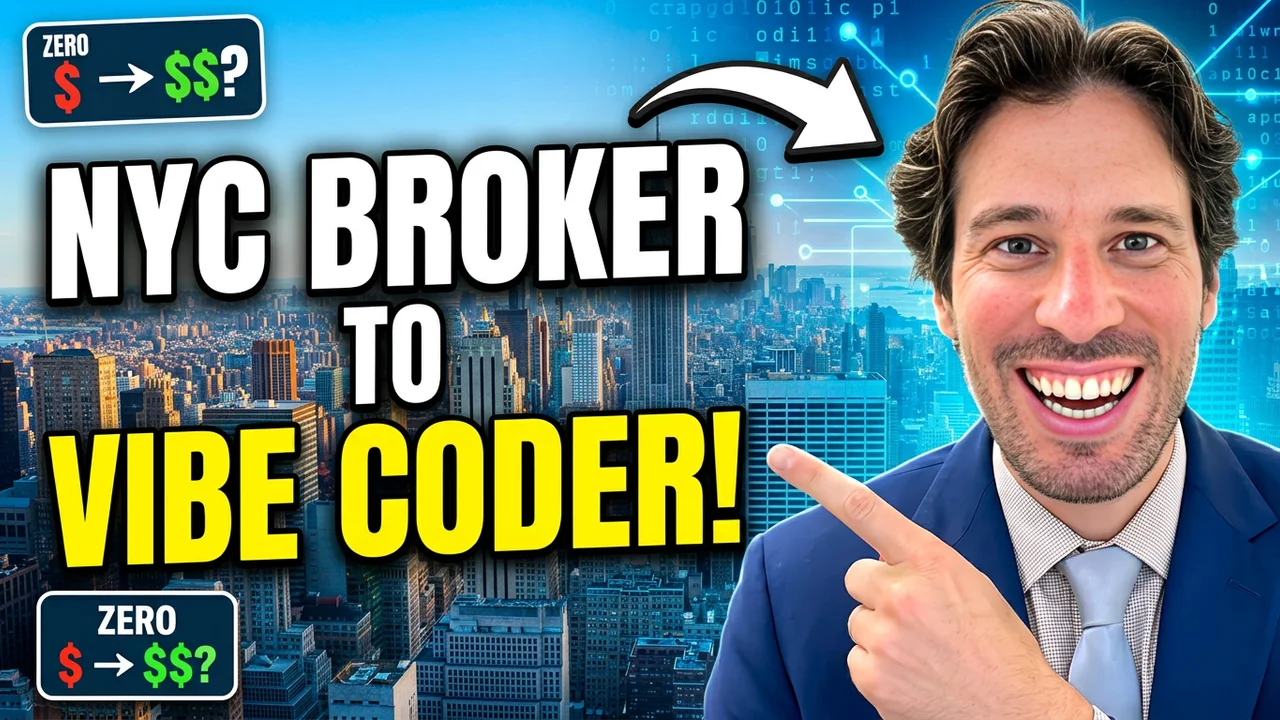
What is the actual problem I'm trying to solve on Day 313?
The problem is zero revenue, and the path to revenue runs through trust. I'm 17 years into running a broker owner business in New York City. Now I'm pivoting to vibe coding and content creation. I have 10,000 subscribers on YouTube. I still make zero money from this channel. That gap — subscribers without income — is the tension I sat down to brainstorm through on Day 313 of building in public.
The funnel is simple in theory. A browser finds my content. If it holds their attention, they become a viewer. A viewer who keeps coming back becomes a subscriber. A subscriber who sees enough consistent value eventually becomes a paying customer. Every stage of that funnel runs on one thing: trust. I don't have enough of it yet.
At [0:52] I said: "my value in this brainstorming session is content creation" — which sounds obvious until you realize I hadn't yet figured out what kind of content creation, or for whom, or through which channels.
Why did 3 niche pivots destroy my YouTube algorithm standing?
YouTube built a model of me as a personal development creator. Then I moved into faith-based content. Then I moved into vibe coding. Each time, the algorithm had to rebuild its understanding of who I am and who should see my videos. By Charles's account, that left the channel in what he called "purgatory" — sitting and waiting for YouTube to recalibrate.
This isn't a minor setback. YouTube's discovery system serves content to audiences it already trusts will engage with it. When a creator's niche shifts 3 times, the platform loses confidence in the match between creator and audience. The result is suppressed distribution even when the underlying content quality improves.
I self-rated my current YouTube trust at 10 out of 100. That's not false modesty — it's a working diagnosis. A channel with 10,000 subscribers but a broken trust signal is effectively starting over.
How does the thumbnail-title relationship actually work?
This is the insight that changed how I think about every upload going forward. I had been treating thumbnails and titles as 2 separate creative decisions. I'd prompt AI for a thumbnail. I'd prompt AI for a title. I'd combine them and upload. The problem is they aren't separate — they're a single unit of communication.
The viewer behavior pattern goes like this: thumbnail → title → thumbnail. A person scrolling their feed glances at the image, reads the text, then looks back at the image to confirm the decision. If the thumbnail raises a question and the title answers it — or vice versa — the viewer clicks. If they don't reinforce each other, the viewer keeps scrolling.
MrBeast is the clearest example of this working at scale. An image of him upside down paired with a title about spending 48 hours upside down creates a loop: the image raises the question, the title confirms the insanity, the image seals the click. I need that loop on every video.
You might also like
What was wrong with my thumbnail prompts before this brainstorm?
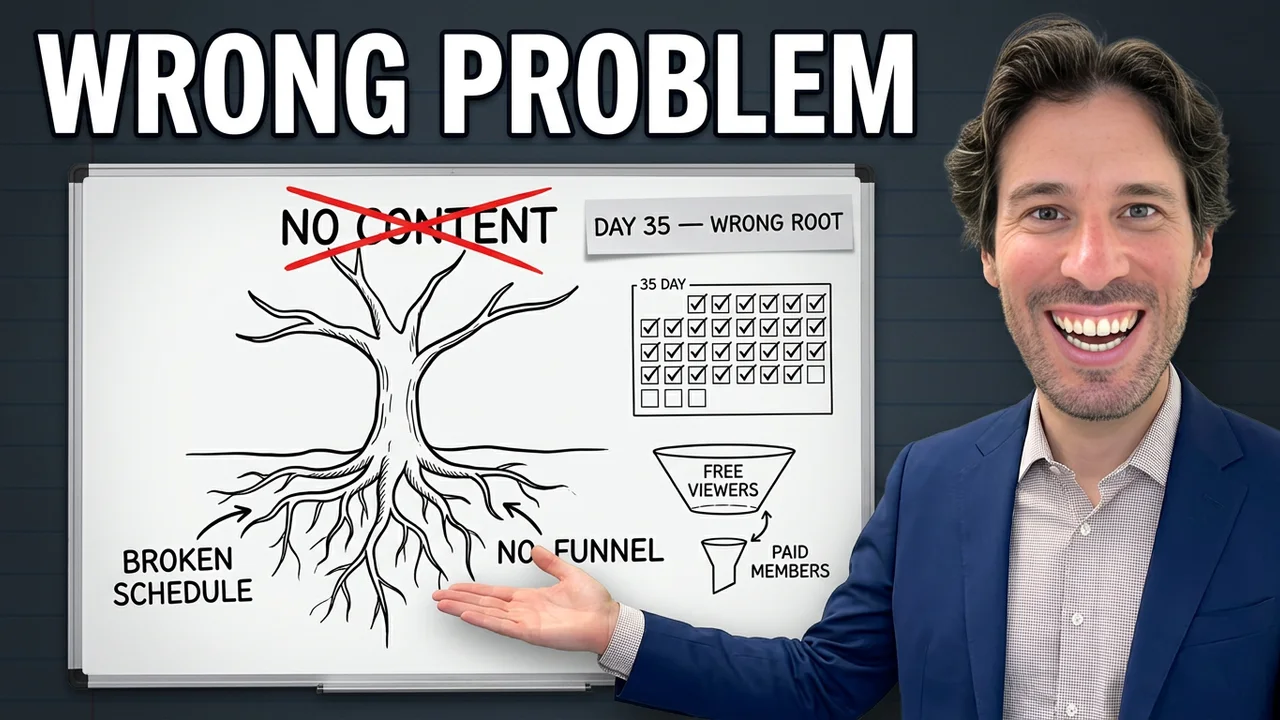
The prompts were too specific and produced no variation. I was generating 1 thumbnail per video. The result was a chaotic image — multiple drawings layered in the background, no clear visual hierarchy — that didn't connect to the title at all.
A thumbnail has 3 layers: the person in the foreground, the text as the middle layer, and the background. When the prompt over-specifies the background, the whole composition becomes cluttered. I had been optimizing the wrong layer.
I also tested Nano Banana and Gemini for thumbnail generation. By Charles's account, neither produced results good enough to use. VidIQ's thumbnail tool was more reliable for scoring and iteration. The VidIQ thumbnail and title optimization tools gave me a structured way to evaluate options rather than just picking the least-bad output.
How can I fix thumbnail-title mismatch to boost YouTube trust?
The fix is to stop treating thumbnails and titles as two separate decisions and start generating them as paired units. Every thumbnail prompt I write now has a corresponding title, and I score the relationship between them before anything goes live — does the image raise the question the title answers? If not, the pair fails and I move to the next one.
This single change closes the trust gap at the top of the funnel. A viewer who sees a thumbnail and title that reinforce each other is more likely to click. A click that converts to a watch signals to YouTube that the match was right. Enough of those signals and the algorithm starts trusting the channel again.
The actionable steps:
- Write 4 distinct title candidates for the video — each framing the content differently.
- Generate a thumbnail prompt specifically matched to each title, not a generic visual.
- Produce 4 thumbnail images using those prompts.
- Score each thumbnail-title pair on relationship strength — does the image raise the question the title answers?
- Select the highest-scoring pair for upload.
- Revamp existing video thumbnails and titles using the same paired approach.
How am I changing my thumbnail workflow after this session?
The new approach came out of thinking out loud during this brainstorm — I hadn't planned it before I started talking. Instead of 1 thumbnail prompt, I'm moving to 4 thumbnail prompts per video, each paired with a corresponding title. Then I score all 4 relationships before choosing which one to upload.
Here's the logic behind each step:
- Write 4 distinct title candidates for the video — each framing the content differently.
- Generate a thumbnail prompt specifically matched to each title, not a generic visual.
- Produce 4 thumbnail images using those prompts.
- Score each thumbnail-title pair on relationship strength — does the image raise the question the title answers?
- Select the highest-scoring pair for upload.
- Revamp existing video thumbnails and titles using the same paired approach.
This also means going back through the existing library. The descriptions were too long. The timestamps probably weren't accurate enough. The thumbnails were disconnected from the titles. All of it needs to be rebuilt against this paired framework.
What is AEO and why does it matter as much as SEO for my content funnel?
AEO (Answer Engine Optimization) is the practice of structuring content so that AI models — Perplexity, ChatGPT, Claude, Gemini — surface it as a source when answering user questions. It sits alongside traditional SEO in the browser-acquisition layer of my funnel.
YouTube is the second-largest search engine. But the largest engines right now are AI models. Someone asking "what are the best running shoes for a marathon" or "when is the Belmont Stakes" is going to an AI answer engine first, not a search results page. Google is actively disrupting its own search product by pushing users toward Gemini. That shift changes where trust needs to be built.
Looking at my own Cloudflare analytics, I could see crawlers hitting the site during a period when I had no content published. The crawlers were there. The content wasn't. That's a trust signal problem — the Google Search crawling and indexing documentation makes clear that crawl frequency and content quality are directly linked. Without content, crawlers have nothing to index, and trust never accumulates.
Text and video work together here. Video feeds YouTube and the visual discovery layer. Text feeds the crawlers — both search bots and AI scrapers from Reuters, AP, and news aggregators. Both channels need to be built simultaneously, not sequentially.
Frequently Asked Questions
What questions do builders ask about rebuilding a content funnel from scratch?
Does having 10,000 YouTube subscribers mean the algorithm trusts my channel? Not necessarily. By Charles's account, subscriber count and algorithmic trust are different signals. A channel that pivoted niches 3 times can have 10,000 subscribers and still receive suppressed distribution because the platform's audience-matching model was disrupted each time. Trust is rebuilt through consistent niche signals and improving click-through rate, not through subscriber count alone.
What is the difference between SEO and AEO for a content creator? SEO targets search engines like Google — it's about ranking in text-based results pages. AEO targets AI answer engines like Perplexity, Claude, and Gemini — it's about being cited as a source when an AI model answers a user's question. Both run on crawlable text content, but AEO rewards direct, factual answers structured so an AI can lift them verbatim. The YouTube search and discovery documentation covers the video-side equivalent of this for on-platform discovery.
Why does a high bounce rate hurt YouTube and Google trust? A high bounce rate signals that visitors arrived and left immediately — meaning the content didn't satisfy what they came for. Both Google and YouTube use engagement signals to decide whether to promote a piece of content further. If people bounce, the platform interprets the content as a mismatch for the audience it served it to, and reduces future distribution.
How does the browser-to-subscriber funnel actually convert? Charles described 4 stages: browser (one-time encounter), viewer (one to two times per week), subscriber (three to four times per week), and paying customer. Each stage requires a higher level of trust and consistent value delivery. The conversion from subscriber to payer is where revenue lives — and it only happens after the earlier stages are working.
Should I fix existing videos or focus only on new ones? By Charles's account, both need attention. Existing videos with broken thumbnail-title relationships and over-long descriptions actively suppress channel trust. Revamping the back catalog using the new paired thumbnail-title framework is part of the rebuild — not optional cleanup. New videos built on the right framework won't fully compensate for a library of low-trust assets still on the channel.
0 Comments
Log in to comment
Not a member yet? Join the community
Pick a meme
KlipyHave a great take?
Drop your email — we'll send a magic link so you can post it. No password.
Not a member of the community? Join today.
Join the community →