Why are people really resisting AI?
The resistance to AI isn't primarily about data centers or energy grids — it's about standards. Specifically, it's about the gap between how AI approaches work and how a large portion of the workforce currently does. After 17 years as a broker-owner, I watched AI surface follow-up tasks — birthdays, graduations, anniversaries — that I had never thought to do myself. That moment was clarifying. I wasn't blocked by the technology. I was the bottleneck.
At [3:45] I said: "I'm the backlog right now. I'm the one with low standards because I'm saying I didn't even think of that" — and that admission is the whole thesis of this piece.
What do standards actually mean in the context of AI?
Standards are guardrails on behavior. You wear a suit to a wedding, not shorts. You don't curse in a job interview. These are standards — agreed-upon floors for how we show up. AI operates the same way. It has guardrails on how it answers, how it reasons, and what it refuses to do. Companies build those guardrails in because crossing them would be embarrassing. The result is a tool that is, by design, unemotional, logical, and consistent.
That consistency is exactly what makes some people uncomfortable. When a tool holds a higher standard than the person using it, the person has 2 choices: rise to meet it or reject it.
How did I first notice this pattern in my own work?
I was 17 years as a broker-owner in real estate. AI started surfacing things like: this contact's birthday is today, this client's kid just graduated, this person just got married. The system was telling me who to reach out to and why. My reaction wasn't pride — it was embarrassment. I hadn't built those habits myself. I automated the outreach, and then I had to sit with the uncomfortable truth that a piece of software had higher relational standards than I did.
That's the mirror AI holds up. It doesn't judge you. It just performs at a level that makes the gap visible.
You might also like
Why does low work standards fuel AI resistance?
I was on a train at 9:30 a.m. and spotted a worker in a vest, partially hidden behind a pillar, scrolling his phone. That image stuck with me. It's not an isolated case — I've seen the same pattern at passport offices, DMV counters, VA hospitals, and government agencies. By Charles's account, the work standard in America is at a low point right now. Most people, he argues, don't show up to labor with pride.
This matters because AI shows up with exactly the opposite energy. It reasons, it logs, it follows up, it doesn't get distracted. When your standard is low and the tool's standard is high, the tool feels like a threat. It isn't. It's a benchmark.
The U.S. Bureau of Labor Statistics productivity research tracks long-run output-per-hour trends — the macro backdrop against which this individual-level dynamic plays out.
What is the "SaaSpocalypse" and why does it matter for builders?
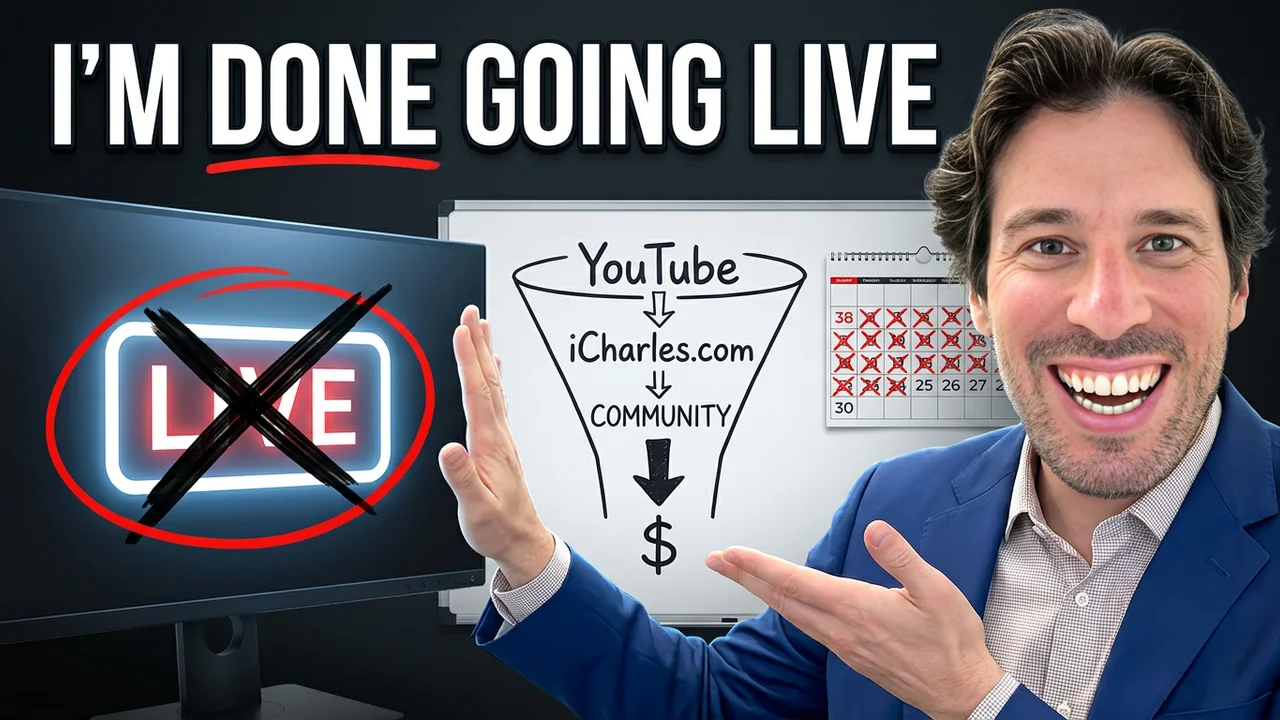
The SaaSpocalypse is the term I use for the coming collapse of subscription software dependency — the moment when a solo builder can own everything a SaaS vendor used to charge them for. CRM, email management, website, news curation: I've moved all of it in-house. I run a Apple Mac Studio as my local build machine. I use Perplexity AI search and news curation to pipe curated news directly to my phone. Nothing I rely on daily is rented from a vendor anymore.
This shift isn't just financial. It changes your relationship to your own work. When you build the tool, you understand the tool. When you understand the tool, your standard rises.
Here is how the two modes compare:
| Mode | What you control | What you pay | Standard required |
|---|---|---|---|
| SaaS dependency | Interface only | Monthly subscription per tool | Low — configure, don't build |
| Owned stack on Mac Studio | Data, logic, integrations | Hardware once | High — you are the engineer |
How does reasoning replace entertainment as a default mode?
I talk about entertainment and distraction as emotional states — not moral failures, but patterns. Scrolling a phone is a feeling. It produces low-grade stimulation with no output. Reasoning is the opposite: it produces output, and output produces standards. This morning I was coding with Fable, which spun up what felt like 100 agents working through a problem on my build. The process was, as I described it on stream, "a lot of logic and very little emotions." That's the mode I'm trying to operate in — and the mode I'm arguing society needs to move toward.
The future I'm building toward is one where every person is a creator and every creator is a builder. Not because it's romantic, but because the economics force it. White-collar and blue-collar disruption is coming at every level. Fighting that with resistance doesn't raise your standard. Building into it does.
What questions do builders ask about AI resistance and standards?
Is AI resistance really about work standards, or is it about job loss fear? Both are real, but Charles argues they're connected. Job-loss fear is loudest when someone's current standard of work is low enough that they can't imagine competing with a high-standard tool. Workers who take genuine pride in their labor tend to say "bring it on" rather than "not in my backyard." The fear and the standard are two sides of the same gap.
How did Charles replace his SaaS stack without a large team? He used a Mac Studio as a local build machine and rebuilt his CRM, email management, and website himself. He uses Perplexity to automate news curation to his phone. The total approach is hardware-once rather than subscription-forever. He describes it as owning his data rather than renting access to it from vendors.
What does AI actually model that humans have stopped doing? According to Charles, AI models unemotional, logical, consistent reasoning. It doesn't scroll, doesn't get distracted, and doesn't skip the follow-up. In his real estate career, it surfaced birthday and graduation outreach he had never built into his own workflow. The gap between what AI did automatically and what he had been doing manually was the clearest measure of his own standard.
Can raising your standards with AI actually make you happier? Charles's framing is that low standards produce discontent — not because of some abstract principle, but because low-standard work doesn't generate the satisfaction that comes from real output. He says rebuilding his own stack on a Mac Studio made his labor "joyful again." The causal chain he draws is: higher standard → better work → more content life.
Who should be building their own stack right now? Charles's answer is solopreneurs and entrepreneurs who are currently paying for SaaS tools they could own. His specific list: CRM, email management, website, and news curation. He frames a Mac Mini or Mac Studio as the entry point — hardware you own once, on which you build everything. The skill required is learning to prompt, reason, and code — not at an expert level, but at a builder level.
0 Comments
Log in to comment
Not a member yet? Join the community
Pick a meme
KlipyHave a great take?
Drop your email — we'll send a magic link so you can post it. No password.
Not a member of the community? Join today.
Join the community →