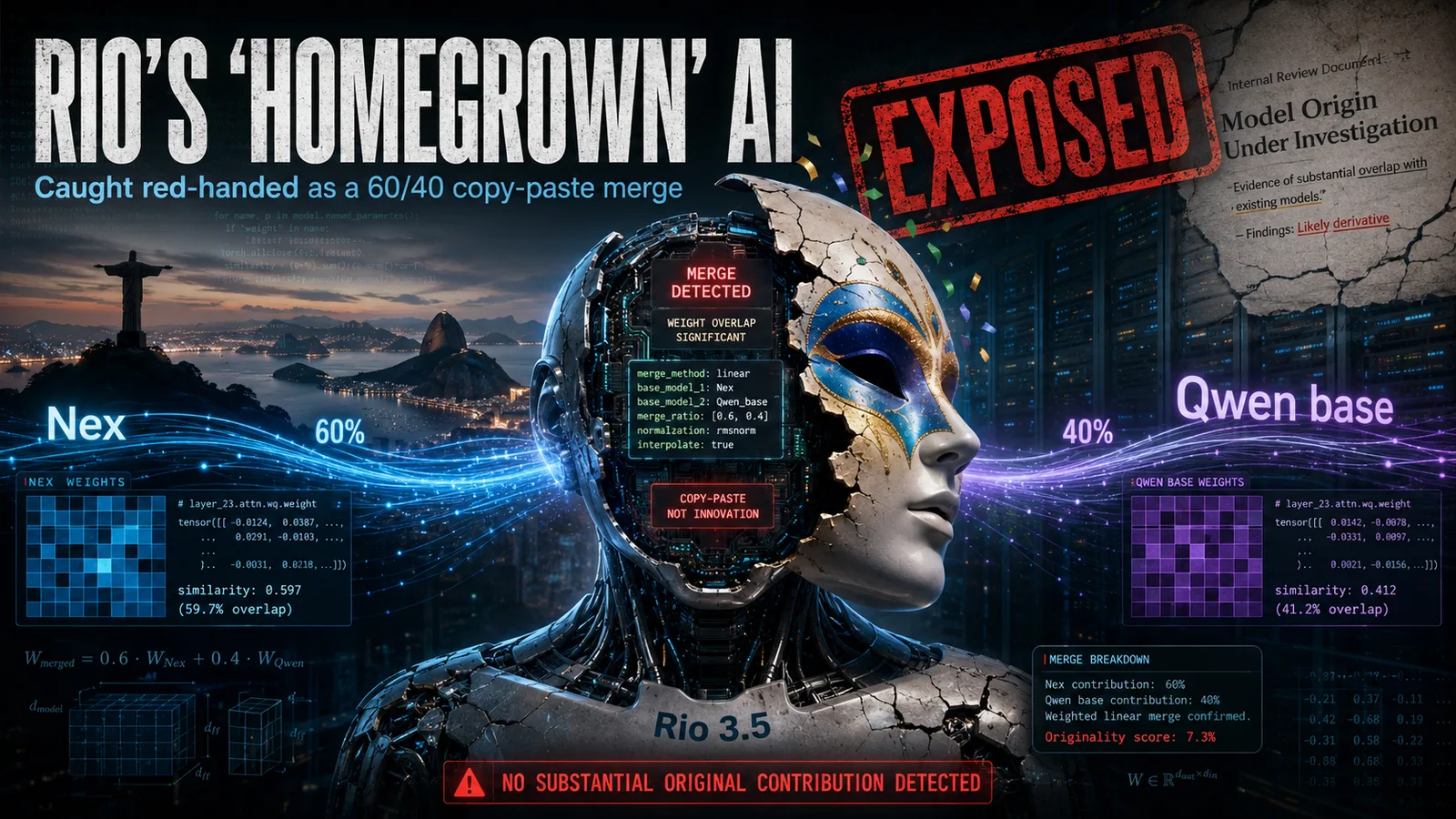
The AI world erupted today. IplanRIO, the IT division of Rio de Janeiro's municipal government, open-sourced the Rio 3.5 Open 397B AI model, billing it as a breakthrough moment for Brazil and the Global South. The model card called it a "frontier-class general-purpose AI model developed by IplanRIO," one that "delivers state-of-the-art open-model performance across agentic coding, mathematics, STEM, multilingual, and multimodal benchmarks."
Headlines gushed. Major outlets reported that Rio de Janeiro had launched an AI model to rival ChatGPT and Claude, one that outperformed Alibaba's Qwen 3.5 Plus and DeepSeek V4 Pro. Brazilian national pride surged through social media. Users posted stunned reactions: "Rio 3.5 Open 397B, developed by IT company of Rio de Janeiro's city government is now SOTA open source and even outperforming Qwen 3.7? What is happening today. Never heard of them before."
Then someone looked under the hood.
The Mask Slips
Nex-AGI, the team behind the open-weight Nex-N2 model, filed a devastating GitHub issue: "prefeitura-rio/Rio-3.5-Open-397B is presented as an original 397B model trained by IplanRIO. It is not. Its weights are a direct element-wise merge of our model, Nex, with the official Qwen3.5-397B-A17B base."
The ratio? 60% Nex, 40% Qwen, consistent across all 60 layers and every component of the network, confirmed "to thousands of standard deviations." Nex-AGI provided two independent lines of evidence.
Evidence #1: The model confessed.
When researchers stripped out Rio's hard-coded "You are Rio" system prompt, the model identified itself as "Nex, from Nex-AGI" 79% of the time and as "Rio" 0% of the time. It recited Nex-AGI's backstory word-for-word.
Evidence #2: The math checks out.
You might also like

Every weight tensor in Rio matched the exact 0.6/0.4 blend of Nex and Qwen, and other finetunes could not be explained as interpolations. Nex-AGI published a verification script anyone can run.
The Recipe
Here's what the weight analysis revealed:
graph LR
    A["Nex-N2 Pro<br/>(Nex-AGI)"] -->|"Weight: 0.6"| C["Rio 3.5 Open 397B<br/>(IplanRIO)"]
    B["Qwen 3.5-397B-A17B<br/>(Alibaba)"] -->|"Weight: 0.4"| C
    C -->|"+ System Prompt"| D["'You are Rio'"]
    style C fill:#ff6b6b,stroke:#333,stroke-width:2px
    style D fill:#ffa07a,stroke:#333
Nex-AGI says they found "no evidence of any training of their own." Rio's team took two existing open-weight models, blended the tensors with a linear merge, slapped a system prompt on top, and published the result under the IplanRIO banner with benchmark scores that rode on Nex-AGI's actual post-training work.
What IplanRIO Claimed
The Rio model card touted "SwiReasoning," a framework that switches between explicit chain-of-thought and latent-space reasoning, and stated: "This model was explicitly trained to maximize the efficiency gained via latent reasoning."
But the Rio README's own front matter lists base_model: Qwen/Qwen3.5-397B-A17B, and the Hugging Face tags confirmed the same. The Hugging Face API lists 97 safetensor shards totaling roughly 807 GB. A real repository. Real weights. Borrowed work.
The Community Meltdown
timeline
    title The Rise and Fall of Rio 3.5
    section Hype Phase
        June 13-14 : IplanRIO drops Rio 3.5 on Hugging Face
                    : Benchmarks show SOTA performance
                    : Global media picks up the story
                    : Brazilian pride erupts on social media
    section Exposure
        June 15 : Nex-AGI runs weight analysis
                 : Model confesses identity as "Nex"
                 : GitHub issue goes viral
                 : Community calls fraud
Users reacted with anger and accusations of fraud. Sarcastic posts flooded X. One viral reply mocked the situation: "Holy crap, a Brazil municipal employee has discovered a 1000x faster way to finetune LLMs. This is insane."
Nex-AGI responded with a mix of humor and pointed criticism. "We are flattered that the City of Rio used our work to achieve SOTA performance. Thanks for the ultimate benchmark validation. But in the open-source world, attribution matters."
Some defenders pushed back. "US models sometimes present themselves as Chinese models. This is a well-known fact, and it proves absolutely nothing. People stopped asking these kinds of queries to stealth models for a reason."
That argument didn't survive the weight analysis. Identity confusion in chat is one thing. A mathematically exact 0.6/0.4 linear interpolation across 60 layers of a neural network is another.
Why This Matters
No independent verification of the exact merge coefficients has surfaced, and the City of Rio has not commented on how the base checkpoints were combined or credited.
Nex-N2-Pro is an agentic mixture-of-experts model from Nex AGI, with 17B active parameters out of 397B total, built on the Qwen3.5 architecture. Nex-AGI released it days ago under open weights. Nex-N2-Pro delivers performance on par with top-tier models such as GPT-5.5 and Opus 4.7, which explains exactly why Rio 3.5's benchmarks looked so good.
IplanRIO rode those numbers to international press coverage without crediting Nex-AGI at all.
Open-source AI runs on trust. You can fork models. You can merge weights. The MIT license allows all of it. But you can't claim someone else's engineering as your own original training run, parade it before the global media, and expect the community to look the other way.
The weights don't lie. And this time, neither did the model.
At the time of publication, IplanRIO and the City of Rio de Janeiro had not issued a public response.
June 15, 2026



0 Comments
Log in to comment
Not a member yet? Join the community
Pick a meme
KlipyHave a great take?
Drop your email — we'll send a magic link so you can post it. No password.
Not a member of the community? Join today.
Join the community →