What is NVIDIA's Rubin platform and why does 45°C matter?
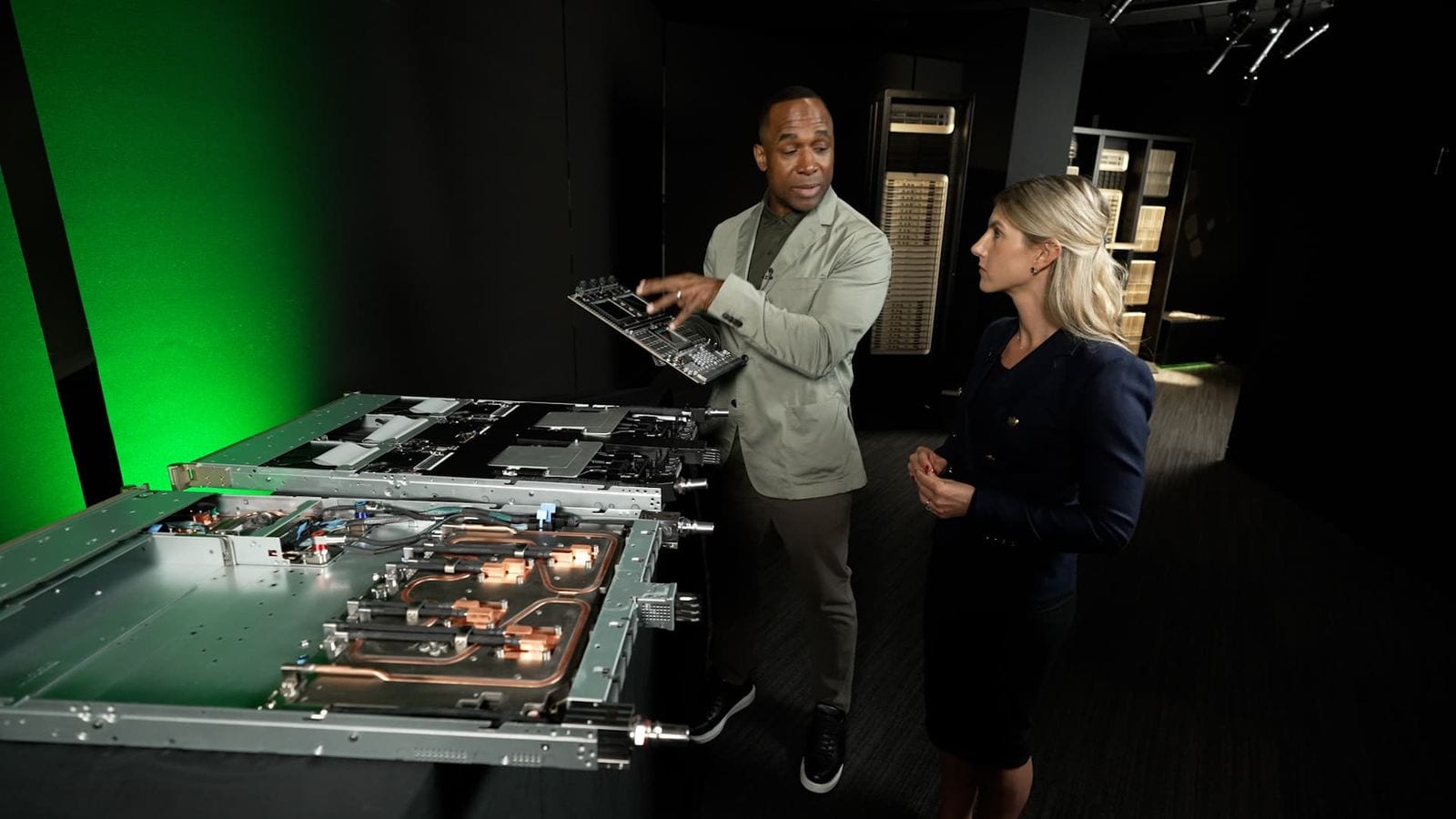
NVIDIA's Vera Rubin platform is the world's first AI server architecture to achieve 100% liquid cooling across every chip and networking component. On June 21, 2026, NVIDIA published a blog post calling the design "one of the most significant energy efficiency breakthroughs in data center history." Mass production and shipments are scheduled to begin this autumn.
The 45°C coolant temperature is the core of the design. Hot tub water typically runs 38°C to 40°C — most people step out after 15 minutes. NVIDIA's coolant runs hotter than that, and that elevated temperature is what makes the system more efficient, not less.
How does 45°C coolant actually reduce energy use?
The principle is counterintuitive. Hotter coolant means outdoor dry coolers can reject heat efficiently without mechanical chillers. According to Telborg, raising chiller plant temperatures by just 1°C cuts cooling energy costs by roughly 4%. Cooling can account for up to 40% of a data center's total electricity use.
The coolant itself is 75% water and 25% propylene glycol. It enters processors at 45°C and exits at roughly 55°C after absorbing heat. Cold plates mounted directly on processors keep device temperatures within operating specs throughout.
You might also like




What does zero water consumption mean in practice?
Conventional cooling towers consume roughly 2.6 million gallons of water per megawatt per year. NVIDIA's closed-loop dry-cooler design reduces that to near zero in favorable climates — requiring chillers for only about 1% of annual operating hours in some geographies.
Ali Heydari, NVIDIA's Director of Data Center Cooling and Infrastructure, stated: "Under NVIDIA's DSX reference design for AI factories, we've eliminated substantial electricity usage and nearly all water consumption."
Here's what we know so far about the financial impact: Omega Technology reports that a 50-megawatt hyperscale facility transitioning to this architecture can save more than $4 million annually in combined energy and water costs.
How is Rubin's architecture different from previous liquid-cooled servers?
Previous liquid-cooled servers used hybrid approaches. GPUs and CPUs got cold plates, but other components still relied on air cooling and finned heat sinks. Rubin's thermal engineering team redesigned the entire cooling loop so liquid reaches every component.
| Feature | Previous Hybrid Servers | NVIDIA Rubin |
|---|---|---|
| GPU/CPU cooling | Cold plates | Cold plates |
| Other components | Air cooling + heat sinks | Full liquid cooling |
| Front panel | Perforated bezel | Sealed panel |
| Rack units per system | 6U | 2U |
| Fans | Required | Zero |
| Noise level | 85+ decibels | Near-silent |
The sealed front panel replaces perforated bezels. Systems that previously occupied six rack units now fit in two. Noise drops from 85-plus decibels — a level requiring hearing protection — to near-silent operation.
Who must switch to liquid cooling, and when?
NVIDIA stated that all cloud service providers and data center operators building systems for the Rubin platform must complete their transition to liquid cooling. There is no hybrid option for Rubin infrastructure.
Richard Whitmore, President and CEO of Schneider Electric, put it plainly: "Once the power consumption of a single chip reaches a certain threshold, liquid cooling ceases to be optional — it becomes essential." Motivair, Schneider Electric's advanced cooling division, is named as an ecosystem partner in the Rubin rollout.
The shift is also reshaping where investment flows in AI infrastructure. Analysts at Guojin Securities noted that the bottleneck for AI computing capacity is moving from chip supply to power and thermal management supply. As GPU and ASIC power consumption rises, constraints are extending into power distribution, cooling, and on-site energy generation — not just chips and servers.
This infrastructure shift connects to broader trends in AI infrastructure costs and the physical demands of scaling AI compute. It also parallels the kind of systemic build-out decisions being made by AI robotics companies and enterprise tech teams using AI for complex analysis.
What are the key numbers from the Rubin cooling announcement?
- 45°C — maximum coolant operating temperature
- 55°C — coolant exit temperature after absorbing chip heat
- 2.6 million gallons — water consumed per megawatt per year by conventional cooling-tower systems
- ~0% — water consumption target for Rubin in favorable climates (chillers needed ~1% of the year)
- 40% — share of data center electricity that cooling can consume
- ~4% — cooling energy cost reduction per 1°C increase in chiller plant temperature
- $4 million+ — annual savings for a 50-megawatt facility switching to liquid cooling
- 3x — rack density increase (6U systems reduced to 2U)
When does Rubin go into mass production?
According to NVIDIA's public press release from early June 2026, the Vera Rubin platform is scheduled to officially begin mass production and shipments this autumn.




0 Comments
Log in to comment
Not a member yet? Join the community
Pick a meme
KlipyHave a great take?
Drop your email — we'll send a magic link so you can post it. No password.
Not a member of the community? Join today.
Join the community →