What happened at Valiant Shield 2026?
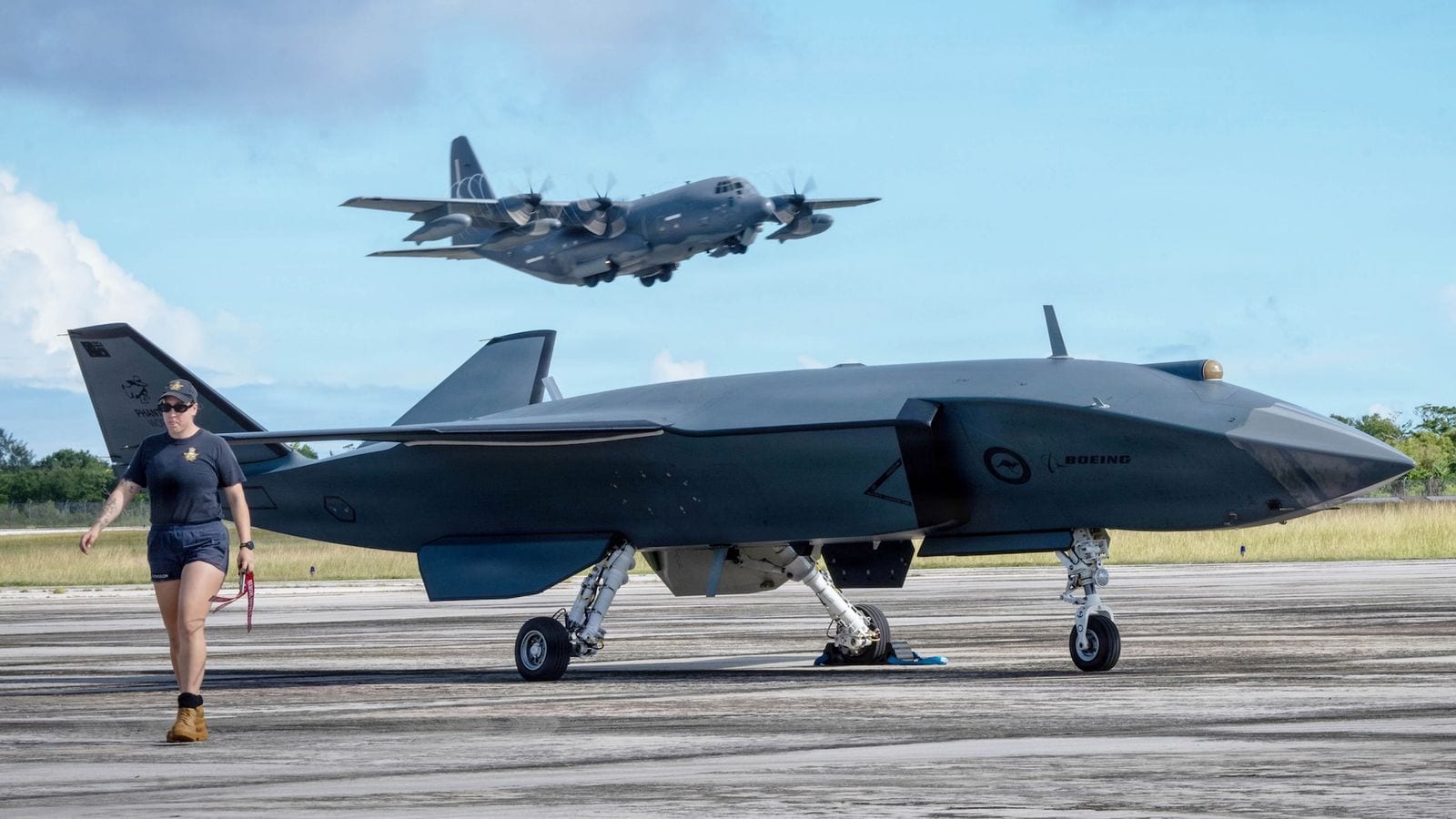
Boeing's MQ-28 Ghost Bat flew at Valiant Shield 2026 in June, becoming the first and only collaborative combat aircraft (CCA) deployed to a multinational, joint operational exercise. The Australian-developed uncrewed aircraft operated alongside U.S. Pacific Command forces near the Marianas Island Range Complex in the Western Pacific.
The exercise included crewed platforms such as the F-35A, F-35B, F-15EX, HC-130, E-3, E-2D, EA-18G, and RC-135. Forces used the exercise to refine tactics, techniques, and procedures around CCA integration, according to Mirage News.
What is the MQ-28 Ghost Bat?
The MQ-28 Ghost Bat is an uncrewed collaborative combat aircraft built by Boeing Defence Australia. It is designed to team with 4th, 5th, and 6th-generation crewed aircraft to extend their reach and awareness in contested environments.
Boeing's product page lists the aircraft's key specs: 38 feet long, a wingspan of 24 feet, a range of more than 2,000 nautical miles, a top speed of up to Mach 0.9, and a service ceiling above 40,000 feet. Boeing says it costs roughly one-tenth of a crewed platform by design.
What were the goals of the Valiant Shield deployment?
The USAF's Experimental Operations Unit used the exercise to pursue CCA integration objectives. Specifically, forces tested interoperability and interchangeability between the MQ-28 and crewed platforms, and worked to prove the aircraft's ability to deploy and integrate into a joint force.
You might also like




Steve Parker, president and CEO of Boeing Defense, Space & Security, said: "We've proven that it's combat capable and now U.S. military, along with allied and partner forces, are able to test it first-hand and experience the value and advantage that CCA bring to the force mix."
Amy List, vice president and managing director of Boeing Defence Australia, called the MQ-28 "the most proven, mature CCA in allied nations."
What is Valiant Shield?
Valiant Shield is a biennial exercise focused on integrating the joint force. It trains real-world proficiency in detecting, locating, tracking, and engaging units at sea, in the air, on land, and in cyberspace across a range of mission areas.
How does the MQ-28's architecture support allied forces?
The MQ-28 uses open mission systems and government reference architectures. Boeing says this allows defense forces to rapidly integrate sovereign payloads for their specific mission needs. Its modular nose design enables quick payload swaps.
Here's what we know so far about the aircraft's broader deployment history, based on the sources:
| Milestone | Detail |
|---|---|
| First flights in Australia | Developed and initially tested by Boeing Defence Australia |
| First U.S. flights | Three flights at Point Mugu Sea Range, NAS Ventura County, California |
| Point Mugu announcement | Boeing announced May 27, 2026 |
| Valiant Shield 2026 | June 2026, Marianas Island Range Complex, Western Pacific |
| First multinational joint exercise | Valiant Shield 2026 — a first for any CCA |
What did the Point Mugu flights prove?
Before Valiant Shield, Boeing announced on May 27, 2026, that the MQ-28 had completed three flights at the Point Mugu Sea Range in California — its first flights outside Australia. The Aviationist reported that the goal was to validate autonomous operations and show rapid deployment from an allied location.
Glen Ferguson, MQ-28 global program director, said: "MQ-28 is using this location to further prove the maturity of the program and inform future exportability."
The aircraft that flew at Point Mugu, identified as ATS-008, carried an all-gray livery and featured an Infra-Red Search and Track (IRST) sensor on the nose along with Boeing's Phantom Works logo on the tail.
Which aircraft flew alongside the MQ-28 at Valiant Shield?
- F-35A
- F-35B
- F-15EX
- HC-130
- E-3
- E-2D
- EA-18G
- RC-135
- Various other joint and coalition aircraft
This mix of platforms reflects the MQ-28's stated design purpose: teaming with 4th, 5th, and 6th-generation aircraft to enhance the whole fleet's capability.
The MQ-28's open-system architecture is part of a broader trend in autonomous military systems — similar to how autonomous warehouse robots and humanoid production lines are being tested for real-world operational integration. The push to validate autonomous systems in live operational settings spans both defense and commercial sectors. Separately, drone incidents near civilian aircraft have also sharpened public attention on uncrewed aircraft operating in shared airspace.
Boeing's next confirmed step is continued maturation of the MQ-28 program, with Valiant Shield 2026 described by Boeing Defense as "just the start" of demonstrating how human-machine teaming extends the reach of crewed platforms.




0 Comments
Log in to comment
Not a member yet? Join the community
Pick a meme
KlipyHave a great take?
Drop your email — we'll send a magic link so you can post it. No password.
Not a member of the community? Join today.
Join the community →