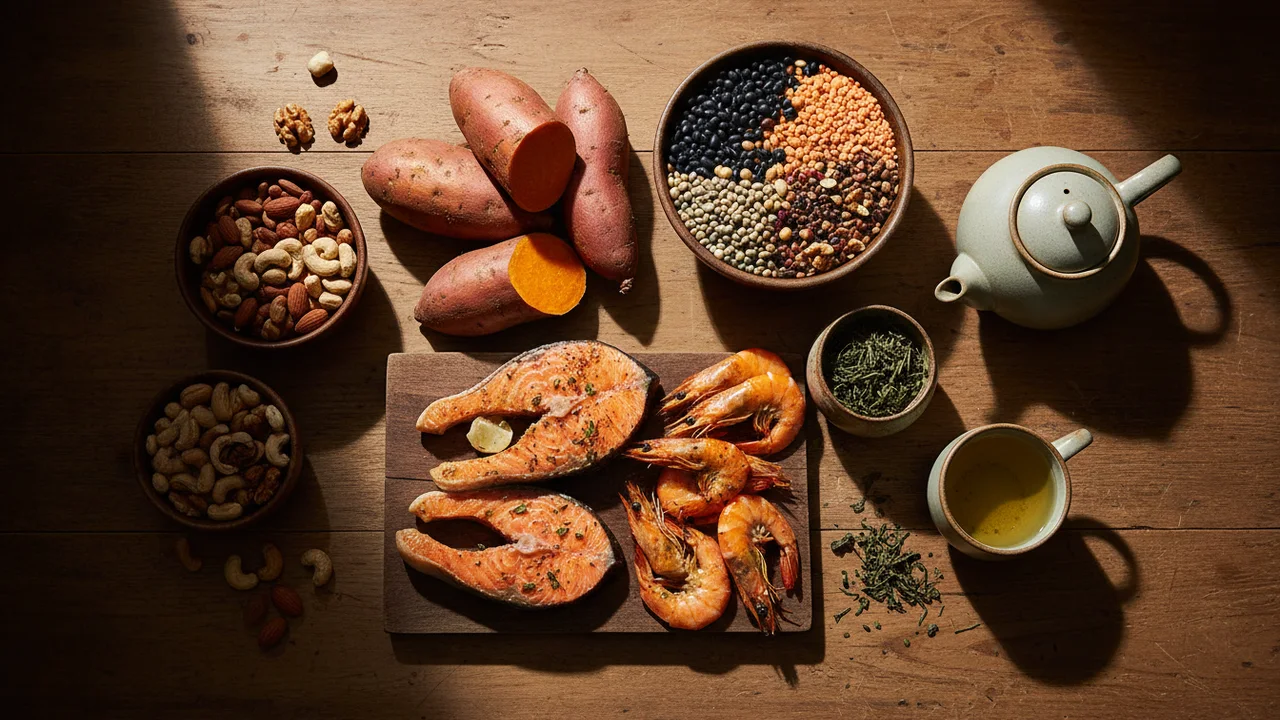
The top foods for longevity are sweet potatoes, seafood, leafy greens, legumes, whole grains, nuts, and green tea — the staples that gave Okinawans a 40% lower risk of cardiovascular disease than other Japanese, per the National Institute on Aging's 2019 work. These are plant-heavy, high-fiber, minimally processed foods eaten in the world's longest-lived communities. Eat them most days and you shift the odds toward a longer healthspan.
What are the key components of a longevity diet?
A longevity diet is mostly plants, high in fiber, and low in ultra-processed food. Across the Blue Zones — the long-lived regions Dan Buettner mapped for National Geographic — roughly 90% of calories come from vegetables, legumes, whole grains, and fruit, with meat eaten a few times a month.
Fiber does a lot of the heavy lifting. A high-fiber diet built on legumes, whole grains, and fruit lowers the risk of heart disease, type 2 diabetes, and several cancers, according to the American Heart Association's dietary guidance. Fiber feeds gut bacteria, steadies blood sugar, and keeps you full on fewer calories.
The core building blocks:
- Fiber-rich carbs — beans, lentils, oats, brown rice, sweet potatoes
- Leafy greens and colored vegetables, several servings a day
- Omega-3 seafood — sardines, salmon, mackerel — two to three times a week
- A daily handful of nuts and seeds
- Green tea and water as default drinks, not soda
How do the Okinawa and Mediterranean diets extend life?
Both diets extend life by replacing processed food and red meat with plants, fiber, and healthy fat. The Okinawa diet — heavy on sweet potatoes and seafood — is linked to a 40% lower risk of cardiovascular disease and a 30% lower risk of cancer versus the general Japanese population, per the National Institute on Aging's 2019 review.
The Mediterranean pattern gets similar results through a different plate. A 2014 Harvard School of Public Health analysis found it added about 4.5 years of life for women and 3.5 years for men. Its base is olive oil, vegetables, legumes, fish, and whole grains, with wine in moderation and little red meat.
You might also like




The lesson is not the specific cuisine. It is the shared structure: high fiber, high plant volume, omega-3 fats, and almost no ultra-processed food.
What role do nuts and green tea play in lifespan?
Nuts and green tea are two of the most efficient single additions you can make. Eating nuts daily is associated with a 20% lower risk of death from all causes, according to a 2013 Harvard School of Public Health study of over 100,000 people. A small handful — almonds, walnuts, pistachios — is enough.
Green tea earns its place too. Regular green tea drinking is linked to a 12% lower risk of death in women and a 10% lower risk in men, based on a 2019 National Cancer Institute analysis. The active compounds are catechins, plant antioxidants that reduce inflammation.
Neither is magic on its own. They work because they replace worse options — nuts instead of chips, green tea instead of soda — while adding fiber, fats, and antioxidants.
What I eat around a 5am triathlon block
I train for Ironman-distance races, and my food choices get tested every hard week, not in theory. During a 5am brick session — a long bike straight into a run — I learned that what I ate the day before decided whether I bonked at mile three or held pace. Processed carbs the night before left me flat. Lentils, sweet potato, and salmon left me steady.
So my everyday plate is built for recovery, and it happens to be a longevity plate. Oats and berries before dawn. A fist of nuts mid-morning. Beans, greens, and fish at dinner. Green tea instead of a third coffee.
Faith keeps it honest. I treat my body as something I steward, not something I punish — which means eating for the decades ahead, not just the next race. Discipline you can hold for 30 years beats a strict diet you quit in 30 days.
How can you build these foods into daily meals?
Start by changing defaults, not by overhauling everything at once. The fastest wins are swapping one processed food for a whole one at each meal and adding a plant to every plate.
A simple day that hits the targets:
- Breakfast: oats with berries and walnuts
- Lunch: a large salad with chickpeas or lentils and olive oil
- Snack: a handful of almonds and green tea
- Dinner: salmon or sardines, sweet potato, and greens
- Drinks: water and green tea; coffee is fine, soda is not
Do that most days and the numbers take care of themselves. You will hit 30-plus grams of fiber, several servings of vegetables, omega-3s, and daily nuts without counting anything.
Which longevity foods give the best return?
The best return comes from the foods with the strongest evidence and the lowest effort: daily nuts, regular seafood, legumes, and green tea. The table below ranks the patterns and foods with published benefits by their primary source.
| Food or diet | Measured benefit | Primary source |
|---|---|---|
| Okinawa diet | 40% lower CVD, 30% lower cancer risk | NIA, 2019 |
| Mediterranean diet | +4.5 yrs (women), +3.5 yrs (men) | Harvard SPH, 2014 |
| Daily nuts | 20% lower all-cause death | Harvard SPH, 2013 |
| Regular green tea | 12% (women) / 10% (men) lower mortality | NCI, 2019 |
| High-fiber diet | lower heart, diabetes, cancer risk | AHA, 2017 |
No single food makes you live longer. The benefit comes from eating these together, most days, for years — the long game Peter Attia describes in Outlive and the aging-slowdown David Sinclair frames in Lifespan.




0 Comments
Log in to comment
Not a member yet? Join the community
Pick a meme
KlipyHave a great take?
Drop your email — we'll send a magic link so you can post it. No password.
Not a member of the community? Join today.
Join the community →