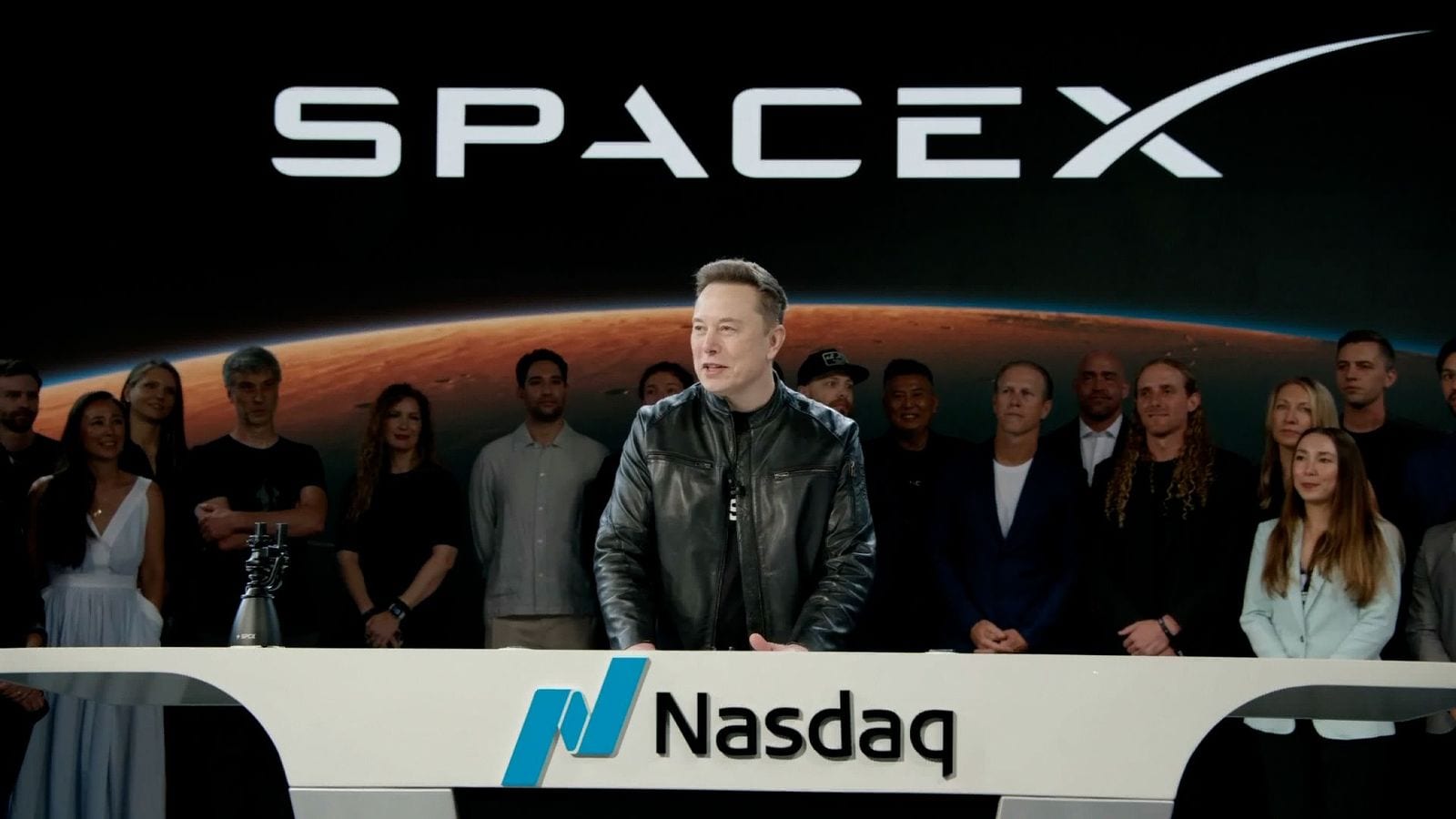
What happened to SpaceX stock this week?
SpaceX shares fell from an all-time high of $225.64 on June 16 to $174.90 by June 18, 2026 — a 22% drop in two trading days. The decline erased roughly $620 billion in market value, pulling SpaceX's market cap down from about $2.99 trillion to $2.37 trillion, according to Forbes. Even after the selloff, SPCX closed its first full week 37% above its $135 IPO price.
How did SpaceX get to $225 in the first place?
SpaceX priced the largest IPO in history at $135 per share on June 10 and began trading on Nasdaq on June 12. The offering raised $75 billion and was anchored by $5–10 billion from BlackRock. About 30% of shares went to retail investors via Robinhood, Fidelity, and Schwab.
Only around 4–5% of SpaceX's total shares entered the public float at listing. That thin supply meant even modest buying moved the price sharply. SPCX climbed from $135 to $225 in under four sessions, briefly pushing its market cap past $2 trillion.
Investor demand during those first three sessions was striking. According to a Vanda Research note cited by Forbes, investors purchased $369.8 million in SpaceX shares over that stretch — more than four times the $88.2 million poured into Nvidia over the same period.
Before the IPO, iCharles covered the SpaceX bond sale that set the stage for this listing.
You might also like

Why did SpaceX stock drop so fast?
Four factors converged to reverse the rally.
The Cursor deal. On June 17, SpaceX disclosed a $60 billion all-stock acquisition of Cursor, an AI coding startup. The deal represents roughly 3.4% dilution of SpaceX's $1.77 trillion IPO valuation. Morningstar analysts cut their fair value estimate for SPCX to $62 from $63, citing "sizable dilution," and said a best-case scenario would price shares at $169 if AI revenue improves.
Options market opened. SPCX options began trading on June 17 for the first time. Before that date, there was no liquid instrument to short the stock. Selling pressure appeared within hours. Susquehanna analyst Chris Murphy wrote that there was a 15% chance the stock would lose half its value over the next three months because of option trades.
Thin float mechanics. With only 4–5% of shares in public hands, price moves in either direction are amplified. The same dynamic that pushed SPCX up fast can push it down fast.
Federal Reserve signal. The Fed signaled on June 17 that it may raise interest rates later this year. That pushed long-duration growth stocks lower across the Nasdaq. SPCX, trading at a substantial premium to near-term earnings, was hit harder than most.
How did analysts react to the Cursor deal?
Reactions were split. Morningstar lowered its fair value estimate and flagged dilution risk. Oppenheimer analyst Timothy Horan took the opposite view. He raised his price target to $250 from $190, writing that "this deal is beneficial for both sides." Horan argued Cursor gains access to SpaceX's computing power, while SpaceX gets Cursor's AI technology, engineering talent, training data, and user base.
Swissquote analyst Ipek Ozkardeskaya had already called SpaceX "the latest meme stock," saying investors are buying "in the expectation that others will buy too and push the price higher." She also argued SpaceX is "burning cash," with its Starlink business unable to offset heavy spending on space exploration.
Here's what we know so far: analyst opinion on SPCX is unusually wide, ranging from Morningstar's $62 fair value to Oppenheimer's $250 bull case.
What does the Cursor deal mean for AI?
Cursor is an AI coding startup that SpaceX agreed to acquire for $60 billion in stock. The deal connects SpaceX to a fast-moving corner of the AI market. For context on how AI coding tools are reshaping developer workflows, see our coverage of Anthropic's recent deals and OpenAI's clinical AI work.
The acquisition also places SpaceX alongside other large tech players making major AI infrastructure bets — similar to Meta's 1.6 GW data center deal with Crusoe.
Key numbers: SpaceX IPO and selloff at a glance
| Metric | Figure |
|---|---|
| IPO price (June 10, 2026) | $135 per share |
| All-time high (June 16) | $225.64 per share |
| Price on June 18 | ~$174.90 per share |
| Decline from peak | ~22% |
| Gain vs. IPO price (end of week 1) | 37% |
| Market cap at peak | ~$2.99 trillion |
| Market cap after selloff | ~$2.37 trillion |
| Market cap erased | ~$620 billion |
| Cursor acquisition price | $60 billion (all-stock) |
| Share dilution from Cursor deal | ~3.4% |
| Public float at listing | ~4–5% of total shares |
What are the next milestones for SPCX?
Three events will shape how SPCX trades in the months ahead, according to myfindex.com.
- Nasdaq-100 inclusion: SpaceX confirmed it will apply for index membership within 15 trading days of its listing. Inclusion would require passive funds tracking the Nasdaq-100 to buy shares at market price.
- Lock-up expiry: The 180-day post-IPO lock-up expires in December 2026. The bulk of shares — held by Elon Musk, employees, and early investors — remain locked until then. If insiders signal plans to sell, available supply will expand significantly.
- AI IPO pipeline: Analysts describe SpaceX as the opening act in a $3.6 trillion AI and tech IPO wave. OpenAI and Anthropic are both expected to pursue public listings later in 2026. How SPCX trades will anchor price discovery for those offerings. Our earlier reporting on Microsoft's OpenAI models shows how closely the AI sector is watching these market signals.
The 180-day lock-up expiry in December 2026 is the next concrete structural event that could materially change the supply of SPCX shares available to trade.


0 Comments
Log in to comment
Not a member yet? Join the community
Pick a meme
KlipyHave a great take?
Drop your email — we'll send a magic link so you can post it. No password.
Not a member of the community? Join today.
Join the community →