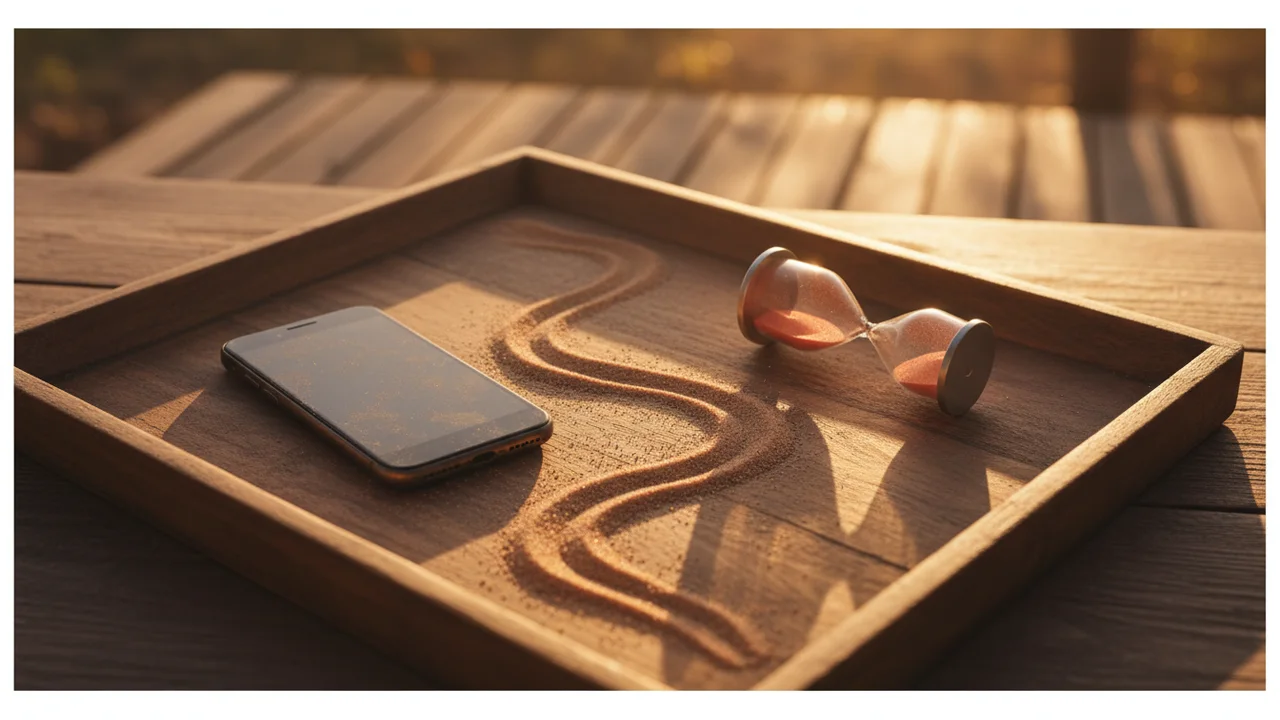
The Pew Research Center reports that 70% of U.S. adults use social media, and most of us open the apps without ever deciding to. To stop wasting time, remove the apps from your phone's home screen, set one hard daily check-in window, silence notifications, and pre-schedule what replaces the scroll. Attention leaks when it has no assignment. Give every hour a job before the feed claims it for you.
Why is social media so hard to put down?
Social media is hard to quit because the apps are engineered to capture attention, not to respect it. Every pull-to-refresh is a small gamble, and unpredictable rewards keep you scrolling far longer than you planned.
The problem is not weak character. You are one person negotiating against a system built by thousands of engineers to hold your eyes. When you fight that with raw willpower, you lose slowly, all day, in ten-second increments.
The fix is to change the terms of the fight. Instead of resisting a tempting app forty times a day, you make the app harder to reach once. Friction beats discipline because friction never gets tired.
What actually happens when you waste time on social media?
Wasting time on social media costs you twice: the hours themselves and the mood that follows. The American Psychological Association's 2021 Stress in America report links heavy social media use to higher stress, anxiety, and low mood.
The second cost is comparison. A survey by the National Opinion Research Center at the University of Chicago found that 60% of adults feel pressured to present a perfect image online. You are not just losing time — you are trading your real life for a highlight reel of everyone else's.
There is a physical cost too. Every hour on the feed is an hour not spent moving, sleeping, praying, or talking to a person in the room. Those are the inputs that actually build health and discipline. The feed gives nothing back.
How do I stop wasting time on social media?
To stop wasting time on social media, redesign your defaults so opening an app takes effort and closing it feels natural. Do not rely on a daily promise to "use it less" — that promise breaks by noon.
Run these six steps in order:
- Measure your baseline. Open Screen Time (iPhone) or Digital Wellbeing (Android) and read your real daily minutes. Fix a number, not a vibe.
- Delete the apps from your phone. Keep access through the browser only. The extra login is enough friction to break autopilot.
- Kill notifications. Turn off every badge, banner, and sound. A silent phone stops interrupting your attention.
- Set one check-in window. Pick a fixed 20-minute slot, once a day. Outside that window, the feed is closed.
- Grayscale your screen. Removing color drains the reward the design depends on.
- Charge the phone in another room. The first and last hour of your day belong to you, not the feed.
| Old default | New default | Why it works |
|---|---|---|
| App on home screen | App deleted, browser only | Adds friction to every visit |
| Notifications on | Notifications off | Removes the interruption trigger |
| Check whenever | One 20-min window/day | Turns grazing into a decision |
| Phone by the bed | Phone charges in another room | Protects your first and last hour |
Do not try all six on a perfect day. Stack one per day for a week, and by Sunday the environment does the work for you.
What a 5am brick session taught me about attention
During a 5am brick session — a hard bike straight into a run — I learned that attention behaves exactly like race-day energy: finite, and gone the moment you spend it carelessly. If I check my phone before that alarm, the workout is already worse. My focus is scattered before my feet hit the floor.
So I made a rule I actually keep: no screen until the session is done. The phone charges in the kitchen. My first hour goes to training and a short prayer, not to a feed. On the days I hold that line, the whole day runs sharper. On the days I break it, I feel behind before 7am.
That is the real lesson. You cannot out-discipline a habit you keep feeding at 5am. You have to remove it from the room. Faith taught me the same thing — you protect what is sacred by guarding the door, not by fighting temptation once it is already inside. Your morning attention is sacred. Guard the door.
What should I do with the time you get back?
Replace the scroll with a specific, pre-planned activity, or the feed will quietly reclaim the gap. An empty hour is not a reward — it is a vacuum, and the app is very good at filling vacuums.
Decide the replacement before you cut the habit. Good swaps include:
- Move your body. A 20-minute walk or a short strength set beats 20 minutes of scrolling on every measure that matters.
- Read on paper. Books like Four Thousand Weeks by Oliver Burkeman reframe time as finite and worth spending on purpose.
- Talk to a real person. Call a friend or family member instead of watching their posts.
- Sit still. Pray, journal, or plan tomorrow. Boredom is where ideas come from.
A University of California, Irvine study on limiting social media found that stepping back improves both stress and focus. The point is not to punish yourself. It is to spend a finite life on things that give something back.
Which tools actually help you cut social media?
The most effective tools add friction or enforce limits you already chose. Built-in phone controls beat most paid apps because they cannot be ignored as easily.
| Tool | What it does | Best for |
|---|---|---|
| Screen Time / Digital Wellbeing | Hard daily cap per app | Enforcing your limit |
| Grayscale mode | Removes the color reward | Reducing the pull to open |
| Focus / Do Not Disturb | Silences apps in set blocks | Training and deep work |
| Delete app, keep browser | Adds a login step every visit | Heavy phone users |
No tool works without a decision behind it. According to Pew Research Center's data on social media use, most adults use these platforms to stay connected — so the goal is not zero. The goal is intentional. Set the boundary, let the tool enforce it, and spend the hours you reclaim on the life you actually want.