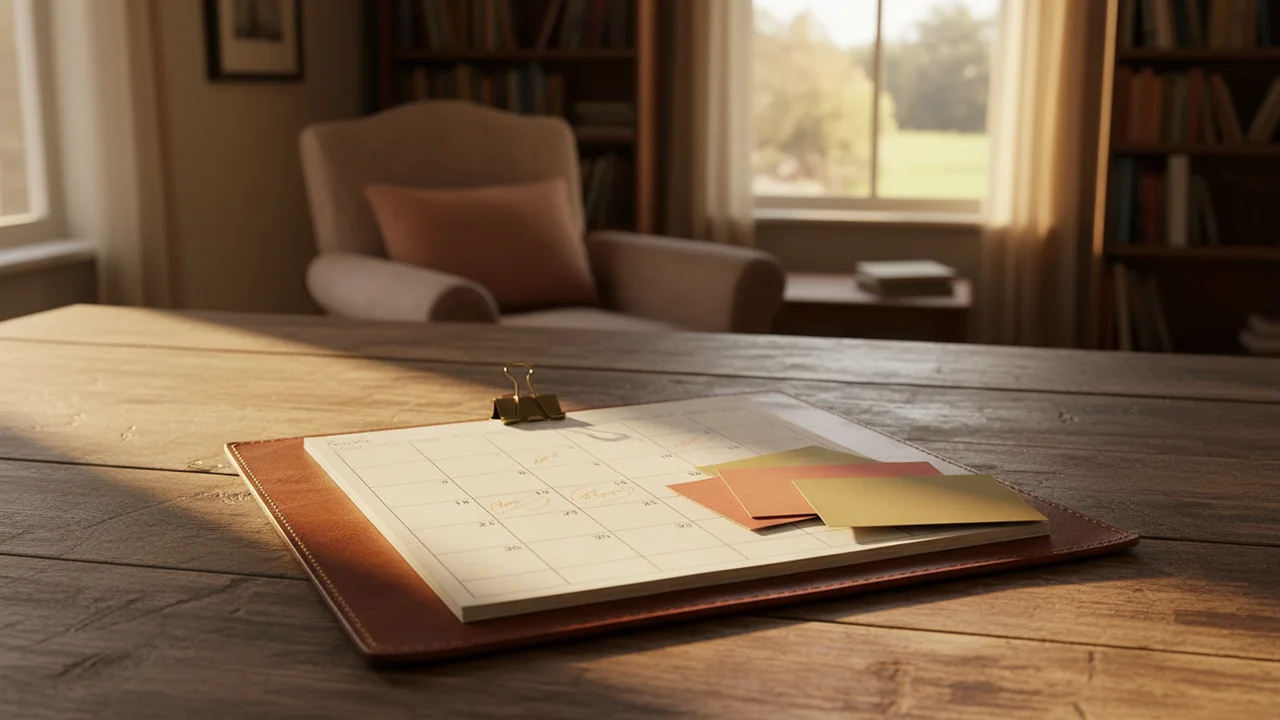
In the American Psychological Association's 2020 Stress in America survey, 64% of adults said keeping a routine helps them manage stress. But a routine only works when you build it around your actual schedule, not an ideal one. Start with two or three keystone habits, tie each to a fixed time and an existing trigger, and track how often you hit them for two weeks before adding anything else.
How do I design a routine that actually works for me?
Design a routine that works by matching it to the life you already live, then adding structure one habit at a time. Anchor each habit to a specific time and an existing cue, keep the first version almost embarrassingly small, and measure adherence before you expand.
The mechanism here is the implementation intention: an if-then plan that pre-decides when and where you act. Gollwitzer and Sheeran's 2006 meta-analysis of 94 studies found these if-then plans had a medium-to-large effect on follow-through. "Meditate more" fails. "After I pour my morning coffee, I sit and breathe for three minutes" works, because the trigger already lives in your day.
Here is the sequence I use with people starting from zero:
- Pick your three non-negotiables — usually sleep, movement, and one deep-work or faith block.
- Assign each a fixed clock time and a trigger that already exists ("after school drop-off," "when the kettle boils").
- Shrink the first version until it feels too easy — five minutes, not fifty.
- Track a simple yes/no each day for 14 days.
- Only add a fourth habit once the first three run above 80% adherence.
What are the real benefits of a daily routine?
A routine lowers stress, protects sleep, and frees mental energy for decisions that matter. The stress link is direct: in that same 2020 APA survey, roughly two-thirds of adults tied a routine to better stress management.
You might also like
Sleep is the second payoff. The National Sleep Foundation recommends a consistent sleep and wake time as a core part of any daily routine, because a stable schedule strengthens your circadian rhythm and improves sleep quality. Fix your wake time first — it anchors everything upstream of it.
The third benefit is well-being. Lyubomirsky, King, and Diener's 2005 review in Psychological Bulletin found that regular positive activities — exercise, connection, meaningful work — are linked to higher productivity and life satisfaction. Building those into a routine means you stop waiting on motivation to make them happen.
What are the key elements of a routine that sticks?
Every durable routine shares four elements: a fixed anchor time, an existing trigger, a small first step, and a feedback loop. Miss any one and adherence drops off fast.
| Element | What it does | Weak version | Strong version |
|---|---|---|---|
| Anchor time | Removes the "when" decision | "Sometime in the morning" | 6:00am, every day |
| Trigger | Links habit to an existing cue | "When I feel like it" | "After I brush my teeth" |
| Small first step | Lowers activation energy | "Run 5 miles" | "Put on running shoes" |
| Feedback loop | Shows the streak, catches drift | No tracking | Daily yes/no check |
A few rules that keep the structure honest:
- Design for your worst day, not your best. If the plan only survives a perfect morning, it fails the first hard week.
- Protect one keystone habit above all others. For me that is the morning training block; it drags the rest of the day into order.
- Leave white space. A routine packed minute-to-minute has no room to absorb a sick kid or a work fire.
What a 5am brick session taught me about routine design
I learned the most about routine design during Ironman training, on the brick sessions — a long bike immediately followed by a run, done at 5am before work. The first month I tried to "feel motivated" the night before and lay out my gear when I woke up. I missed four sessions in three weeks.
What fixed it was removing every morning decision. The night before, my bib, shoes, and bottles went by the door in the same order. My alarm sat across the room. The trigger was simple: feet on the floor, kit already waiting, no negotiation. Adherence went from spotty to near-perfect, and it had nothing to do with wanting it more.
That is the real lesson: discipline is mostly design. My faith practice runs the same way — a fixed early slot, the same chair, the same open page — so it happens on the flat days, not just the inspired ones. When I feel resistance now, I do not push harder on willpower. I go find the missing anchor or trigger and fix the system.
How can I use technology without burning out?
Use technology to remove memory load, not to add pressure. A 2019 Pew Research Center report found that most U.S. adults rely on smartphones and digital tools to organize daily life, and a shared calendar with reminders is the highest-leverage tool for a routine — it moves the "remember to" burden off your brain.
Keep the stack small:
- One calendar, with recurring blocks for your keystone habits set as real appointments.
- One reminder tied to each trigger, not ten notifications fighting for attention.
- One weekly review — fifteen minutes to check what held and what slipped.
Burnout comes from routines built for a fantasy version of you. Avoid it by keeping total commitments low, scheduling genuine rest as its own block, and reviewing weekly so you catch drift before it becomes collapse. A sustainable routine you keep beats an optimal one you abandon in a month.

0 Comments
Log in to comment
Not a member yet? Join the community
Pick a meme
KlipyHave a great take?
Drop your email — we'll send a magic link so you can post it. No password.
Not a member of the community? Join today.
Join the community →