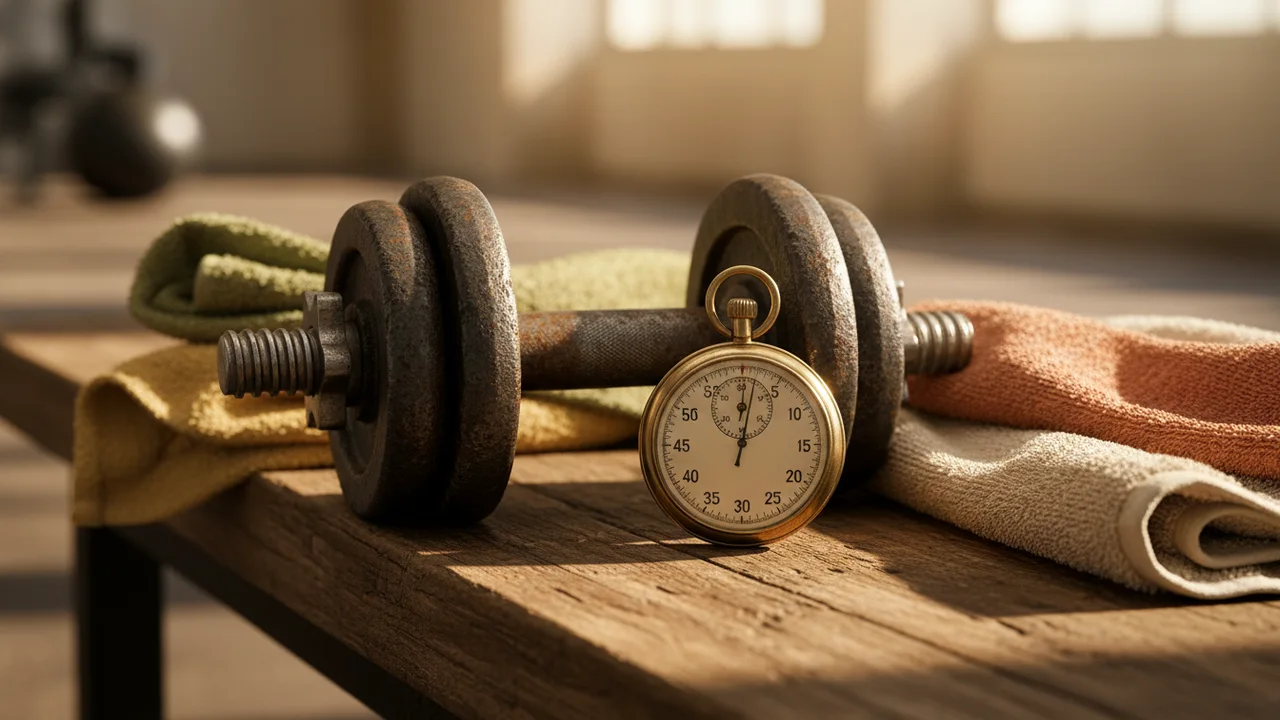
Start with three sessions a week: two full-body strength workouts and one 30-minute aerobic session, matching the National Academy of Sports Medicine's beginner guidance of 2-3 strength days weekly. Keep each workout 20 to 30 minutes, build toward the 150 weekly aerobic minutes the American College of Sports Medicine recommends, and add a little each week. Consistency beats intensity. Pick a plan you can repeat, then actually repeat it.
What are the benefits of building a workout routine as a beginner?
A routine helps beginners because structure converts motivation into repeated action, and repetition is what changes your body. Regular physical activity lowers your risk of heart disease, type 2 diabetes, and several cancers, according to the CDC's physical activity guidance.
A routine also removes daily decision-making. When Monday, Wednesday, and Friday are already "training days," you stop negotiating with yourself each morning. That saved willpower is the real benefit — you spend it on showing up instead of on deciding whether to show up.
Beginners also gain fitness fast because almost any consistent stimulus is new. Your first eight weeks deliver some of the biggest strength and endurance jumps you will ever see. Protect that window with a plan simple enough to keep.
How do I set realistic fitness goals and expectations?
Set one process goal and one outcome goal, then tie both to a calendar. A process goal is "three workouts a week for eight weeks"; an outcome goal is "walk a 5K without stopping." Process goals are the ones you fully control, so weight them heavier.
Expect visible change in 6 to 8 weeks, not 6 to 8 days. Strength climbs first, then endurance, then body composition. If you chase fast aesthetic results, you will usually quit before the slow ones arrive.
Write goals down and make them specific:
- Name the behavior (two strength sessions, one walk or run).
- Name the frequency (per week).
- Name the deadline (eight weeks out).
- Name how you will measure it (a checkmark on a calendar).
What types of exercises should I include in my workout routine?
Build every beginner routine from three ingredients: strength training, aerobic exercise, and mobility work. The National Academy of Sports Medicine recommends beginners strength-train 2 to 3 times per week in its 2020 Essentials of Personal Fitness Training, paired with aerobic work for heart health.
Cover all the major movement patterns instead of chasing single muscles. A complete beginner strength day includes:
- A squat pattern (bodyweight squat, goblet squat)
- A hinge pattern (hip hinge, glute bridge)
- A push (incline push-up, dumbbell press)
- A pull (row, assisted pulldown)
- A carry or core hold (farmer carry, plank)
For aerobic work, pick something you will repeat: brisk walking, easy cycling, swimming, or a run/walk. Mobility is 5 minutes of easy movement before and after — the cheapest injury insurance you will ever buy.
How often and how long should I work out per week?
Work out three to four days a week, 20 to 30 minutes per session at the start. The American Council on Exercise recommends beginners begin with short 20-30 minute workouts and increase duration and intensity gradually. Over several weeks, build toward the 150 weekly minutes of moderate aerobic activity the American College of Sports Medicine recommends for adults.
Here is a simple, repeatable first-month week:
| Day | Focus | Time |
|---|---|---|
| Monday | Full-body strength | 25 min |
| Tuesday | Brisk walk or easy bike | 30 min |
| Wednesday | Rest or mobility | 10 min |
| Thursday | Full-body strength | 25 min |
| Friday | Walk/run intervals | 25 min |
| Saturday | Longer easy walk or hike | 40 min |
| Sunday | Rest | — |
That week gives you two strength days, three aerobic sessions, and two true rest days. It hits the beginner targets without living in the gym.
How can I track progress and stay motivated over time?
Track two numbers — sessions completed and one performance metric — and let progressive overload pull you forward. Progressive overload, gradually increasing weight, reps, or difficulty, drives strength and muscle gains, per a 2018 Journal of Strength and Conditioning Research review. Add one rep or 2 minutes each week; that is the whole engine.
I learned this on the bike, not in a gym. During a 5am brick session — a hard bike straight into a run — I used to fixate on how I felt that morning. Cold, groggy, legs like concrete: it always felt like failure.
The morning I started logging only two things, distance and average pace, everything changed. Feelings lie; the logbook doesn't. Some of my strongest runs came on mornings I felt terrible. Faith taught me the same lesson: you show up for the practice, not the mood. Motivation is a result of consistency, not a requirement for it.
So make the scoreboard boring and honest. Put a checkmark on a calendar for every finished session; a two-week streak becomes its own fuel. Recruit one accountability partner or a coach. And schedule workouts like meetings you cannot cancel — because the beginner who trains an unglamorous, repeatable plan beats the one forever chasing the perfect program.