Your Good Habits Might Be Hiding Your Biggest Problem
A full checklist can leave the most consequential thing untouched. How does a day that looks so disciplined keep producing the same unresolved problem?

You can wake up early, read twenty pages, go to the gym, pray, clear your inbox, and finish the day with a beautiful row of check marks. You can also leave the one thing you most need to confront completely untouched. How does a day that looks so disciplined leave the same problem waiting for you tomorrow?
That is the question I keep coming back to. The good things are still good. But if nine completed tasks can make the tenth—the one you keep avoiding—disappear from the conversation, your checklist is giving you somewhere to hide.
I have been thinking about Darren Hardy’s The Compound Effect and James Clear’s Atomic Habits. Small choices, repeated over time, deserve our attention. My question is what we choose to repeat—and what we keep allowing to work against it.
I want a way to win the day that does not let me win on a technicality.
What are you adding good behavior on top of?
Suppose you want to write a book. You research a morning routine, buy a notebook, watch a video about writing, and organize your notes. Those things can help. They can also fill the time you were supposed to spend writing.
Or you want more business. You polish the website, review the design, draft content, and reorganize your contacts. Meanwhile, the sales calls remain unmade.
The uncomfortable question is not whether those other activities are useful. It is whether they are useful right now, or whether they let you postpone the work that carries the risk of rejection, uncertainty, or an imperfect first attempt.
Clear already makes a useful distinction between being in motion and taking action. I want to apply that scrutiny to the way we keep score: which decisions count as a daily win, which are connected, and which never make it onto the list?
So before adding another improvement, I would make two short lists: three things to remove, and three things to install.
Removing might mean ending the late-night scrolling that keeps eating your bedtime. Installing might mean putting the phone away and beginning a wind-down routine. Removing might mean stopping the round of research that precedes every writing session. Installing might mean drafting two imperfect pages before opening another source.
This is an inventory, not six new daily obligations.
I like threes because it doesn't get too complicated after that.
Three is my limit for keeping the decision manageable. It is not a scientifically optimal number, and it is not a rule I am attributing to Hardy or Clear.
There is evidence for taking subtraction seriously. In research published in Nature in 2021, Gabrielle Adams and colleagues found that people often overlooked useful subtractive changes in problem-solving tasks. The researchers’ university account explains how prompting people to consider removal helped them notice options they had missed.
That does not prove subtraction always beats addition, or that giving something up automatically produces discipline everywhere else. It gives us a better question to ask before making life more crowded: what is already here that keeps undoing the thing I want?
The confidence I am interested in is specific: I kept this boundary, so I have a reason to trust myself with the next commitment. That is something to build and observe, not a promise that one removal fixes the rest of life.
Find the decision the other wins depend on
Consider the connection between drinking in the evening, going to bed, waking up, and getting to the gym. If evening drinking is the behavior disrupting your mornings, a stricter alarm may be aimed at the wrong point in the sequence. An earlier bedtime does not settle the drinking decision for you.
These actions are connected, but they are not identical. Track them separately while you are learning what actually happens. Do not award yourself three independent victories for a chain you have not established.
For someone who drinks heavily or may be physically dependent on alcohol, stopping suddenly can be dangerous; get medical help to plan the change safely. This is not a test of moral worth or a reason to attempt withdrawal alone.
The same dependency question applies without alcohol. If the phone keeps delaying bedtime, and the late night keeps derailing your planned workout, “wake up earlier” may be a downstream target. The decision to charge the phone outside the bedroom might deserve more attention.
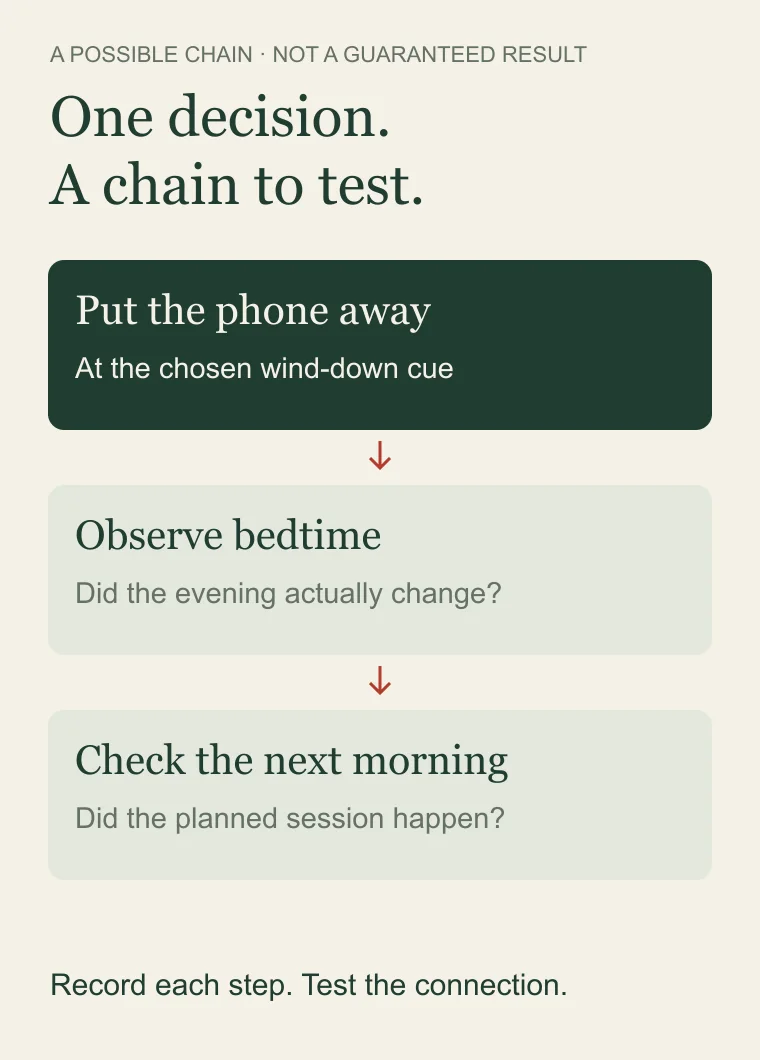
The broader idea has a predecessor: Charles Duhigg describes keystone habits, changes that can influence other patterns. The useful question for this exercise is narrower: which decision am I avoiding while giving myself credit for the easier things around it?
That is the candidate for one of the day’s three wins.
Not because it hurts the most. Difficulty alone does not make something valuable. The sales call may matter because it advances the business. Rest may matter because it supports recovery. An unnecessarily punishing workout does not become the right choice just because it is hard.
Choose the avoided action with a clear connection to what you want—not the most impressive-looking struggle.
Make the important thing small enough to begin
Here is the distinction that makes this workable: the decision can be uncomfortable while the first action is small.
The goal might be a book. Today’s beginning can be one rough sentence. The goal might be a healthier business. Today’s beginning can be dialing the first relevant prospect. The goal might be a half marathon. The beginning of a planned training session can be putting on your running shoes.
Clear’s Two-Minute Rule asks you to shrink a new behavior to an easy starting version. In his gym example, a reader initially limited visits to five minutes. It is an illustration of practicing the act of showing up, not proof that five minutes is enough training for every goal.
The hardest part is putting on your shoes and driving to the gym when it's cold and raining and dark out.
Sometimes the barrier is exactly that ordinary. We imagine the whole workout, the whole manuscript, the whole awkward conversation, and never get through the first action.
One minute can be a legitimate beginning. But be honest about what you are tracking. Opening the document is a start. Writing two pages is an output. Finishing the book is an outcome. Those deserve different labels.
Otherwise, the tiny-start strategy becomes another way to check a box forever while avoiding the work it was meant to help you enter.
Turn three choices into routines you can actually track
I do not particularly like the word habits when I use it to mean “that is just who I am.” I prefer remove, install, and practice. Those words put the next action back within reach.
That is a preference about language, not a claim that habits are fixed. Clear’s own writing on identity describes identity changing through repeated actions.
For each choice, connect four things: the area of life, the goal, the routine, and today’s observable action. In the system I am building, those areas are Spaces. Health is a Space; completing a half marathon is a goal; following a suitable training plan is a routine; today’s planned session is the action. A rest day can be part of that plan.
You can build the same connection on paper. Here is a hypothetical set of three daily choices:
| Area and goal | Remove or interrupt | Install a routine | Small beginning | Evidence beyond starting |
|---|---|---|---|---|
| Health: protect bedtime | Phone use in bed | Charge it outside the bedroom at the chosen wind-down time | Put the phone on that charger | Record bedtime; review whether it changes |
| Creative: draft the book | More research during the writing block | Draft before opening references | Write one rough sentence | Count drafted pages separately |
| Business: reach prospective clients | Another round of cosmetic preparation | Make calls in a defined outreach block | Dial the first relevant prospect | Record attempts and conversations separately |
Your three might involve prayer, family, or something else entirely. The list should reflect your life, not somebody else’s performance of ambition.
It also has to respect your circumstances. A tracker cannot supply missing childcare, money, treatment, or recovery time. Some obstacles call for support, not a harder daily target.
Give each routine a clear cue, a small beginning, and an honest way to record what happened. “Be disciplined” is too vague to track. “After coffee, open the draft and write one sentence before checking messages” tells you what to do.
Then review the connection. If the supposed first domino changes but nothing downstream improves, investigate. Perhaps it was not the main obstacle. Perhaps the next action needs its own cue. A plausible story about your behavior is still a story until you observe it.
Tonight, choose the three that count
Write down three things to remove and three to install. Look for relationships between them. Then select up to three daily commitments from that inventory—not all six, and not a fresh ten-item routine disguised as three headings. If three is too much, begin with one.
For each commitment, finish this sentence: “When ___, I will ___, and I will record ___.” Make the starting action small enough that you can stop negotiating with it. Review the actual work and the goal separately.
I am building tracking around these relationships because I want to see more than a row of completed boxes. I want to know whether the routine connects to the goal, and whether the thing I keep avoiding is still being allowed to run the day.
Save the table if it helps you make those choices. Share it with the person who keeps building a more elaborate routine around an unchanged problem.
Before you call tomorrow a win, ask: did I move the important thing—or just the easier things around it?
PASS THE IDEA ON