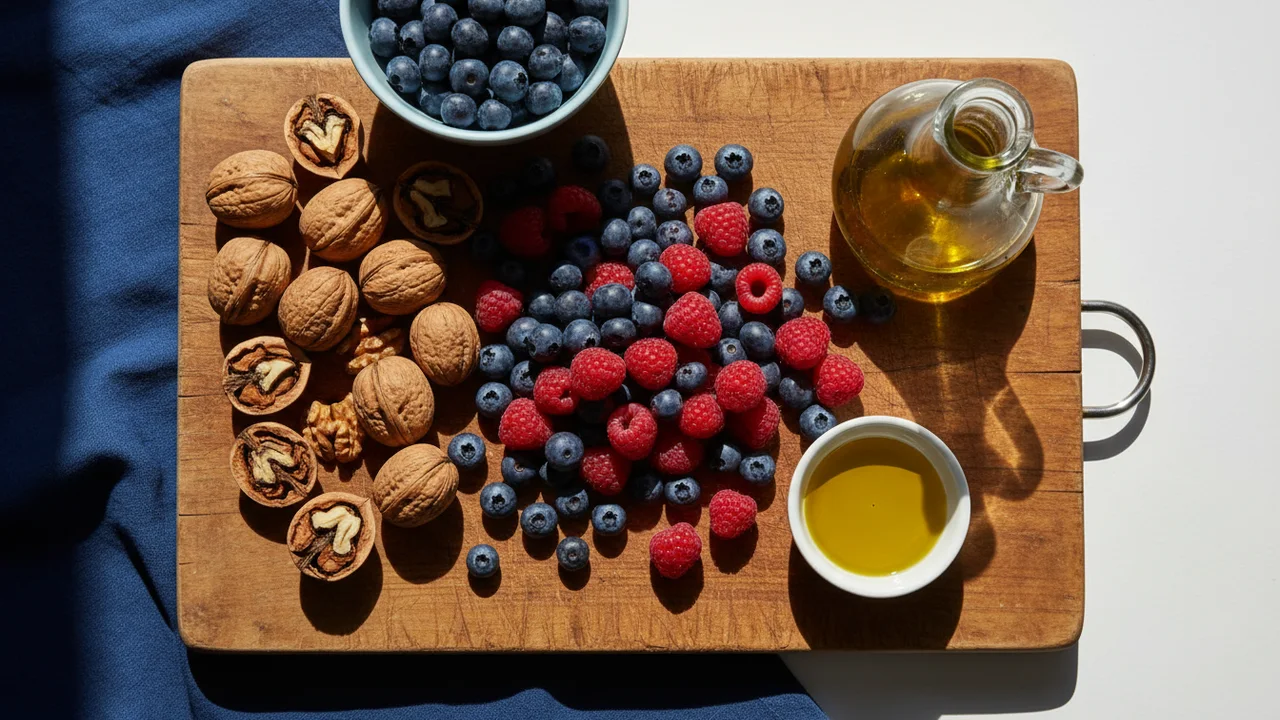
What are the best foods to eat for brain health?
The best foods for brain health are fatty fish, leafy greens, berries, nuts, extra-virgin olive oil, whole grains, and beans - the core of the MIND diet, which Rush University's MIND diet research linked to a 53% lower Alzheimer's risk in people who followed it closely. These foods deliver omega-3 DHA, plant polyphenols, and folate that protect neurons.
No single food is magic. Brain protection comes from a repeated pattern eaten across weeks and years, not one heroic meal. The table below shows what to eat and how often.
| Food | Eat how often | Key brain nutrient |
|---|---|---|
| Fatty fish (salmon, sardines) | 2+ servings/week | Omega-3 DHA |
| Leafy greens (spinach, kale) | 6+ servings/week | Folate, lutein, vitamin K |
| Berries (blueberries, strawberries) | 2+ servings/week | Anthocyanins |
| Walnuts and nuts | 5 handfuls/week | ALA omega-3, vitamin E |
| Extra-virgin olive oil | Daily, as main fat | Polyphenols, healthy fat |
| Beans and legumes | 4+ servings/week | Folate, fiber |
Coffee, tea, and a little dark chocolate fit too, in moderation - they add polyphenols without much sugar. Notice the pattern: whole plants, one oily-fish habit, and olive oil as your main fat. That is most of the job done.
Why do these foods actually protect the brain?
These foods protect the brain by supplying the raw materials it is built from and by lowering the inflammation that ages it. Your brain is mostly fat by dry weight, and omega-3 DHA is a main structural fat in neuron membranes.
Fatty fish and walnuts supply that DHA and ALA. Berries and leafy greens carry anthocyanins, lutein, and folate that reduce oxidative stress. Olive oil polyphenols and fiber-rich beans keep blood vessels flexible, so more oxygen reaches brain tissue. Steady blood sugar from whole grains and legumes avoids the spikes that stress small blood vessels over time. B vitamins from greens and beans also help control homocysteine, a compound tied to faster cognitive decline.
Think mechanism, not miracle: better membranes, less inflammation, better blood flow.
You might also like



What does the research really show?
The strongest evidence points to eating patterns, not single foods. In a 2015 study published in Alzheimer's & Dementia, Rush University researchers found that people with the highest MIND diet adherence had a 53% lower Alzheimer's risk, and even moderate adherence was tied to about a 35% lower risk.
Berries have their own signal. A 2012 study in Annals of Neurology, drawn from the Nurses' Health Study, found that women eating the most blueberries and strawberries had cognitive aging delayed by up to 2.5 years. For a plain, current overview, Harvard Health's roundup of brain foods tracks with these findings.
One honest caution: most of this is observational. It shows strong association, not ironclad proof. But these foods are safe, affordable, and good for the heart too - so the downside of eating this way is close to zero.
How I eat for brain health during a training block
I train for Ironman, and my hardest brain days are my hardest body days. After a 5am brick session - a long bike straight into a run - my head is foggy and my willpower is spent. That is exactly when discipline, not motivation, decides what I eat. So I remove the decision the night before.
My default post-brick breakfast is eggs, spinach, and blueberries with a spoon of walnuts. Twice a week I eat sardines or salmon at lunch. I cook almost everything in olive oil, and beans show up in most dinners. It is boring on purpose. Boring is repeatable, and repeatable is what the research actually rewards.
Faith taught me the same lesson training did: small faithful habits compound. I do not chase a perfect diet. I keep a good one, most days, for years - and that is the version that holds up.
Which foods should you limit for brain health?
Limit ultra-processed foods, added sugar, fried foods, and heavy alcohol - the MIND diet specifically caps butter, cheese, red meat, pastries, and fast food. These raise inflammation and drive blood-sugar swings that work against everything above.
You do not need to be perfect. A useful shortlist to cut back on:
- Sugary drinks and desserts most days
- Fried and fast food
- Processed meats like bacon and deli meats
- More than one alcoholic drink a day
- Refined white bread and pastries
Michael Pollan's rule from In Defense of Food still holds: eat food, not too much, mostly plants. If a product has a long ingredient list you can't pronounce, treat it as a treat, not a staple.
How do you build a brain-healthy plate tomorrow?
Build the plate around plants and one healthy fat, then add fish a couple of times a week. Start tomorrow morning, not next Monday.
Do this in order:
- Make half your plate vegetables, leaning on leafy greens.
- Add a handful of berries daily - fresh or frozen both work.
- Swap your cooking oil to extra-virgin olive oil.
- Eat fatty fish twice a week; sardines are cheap and easy.
- Keep walnuts and beans on hand for fast protein and fat.
- Cut one sugary or ultra-processed item you eat every day.
For a trusted starting point, the National Institute on Aging offers plain healthy-eating guidance for the brain. Pick two of these steps this week, make them boring and automatic, then add the rest. Consistency beats intensity - the same rule that gets you across an Ironman finish line gets you a sharper brain at 70.


0 Comments
Log in to comment
Not a member yet? Join the community
Pick a meme
KlipyHave a great take?
Drop your email — we'll send a magic link so you can post it. No password.
Not a member of the community? Join today.
Join the community →