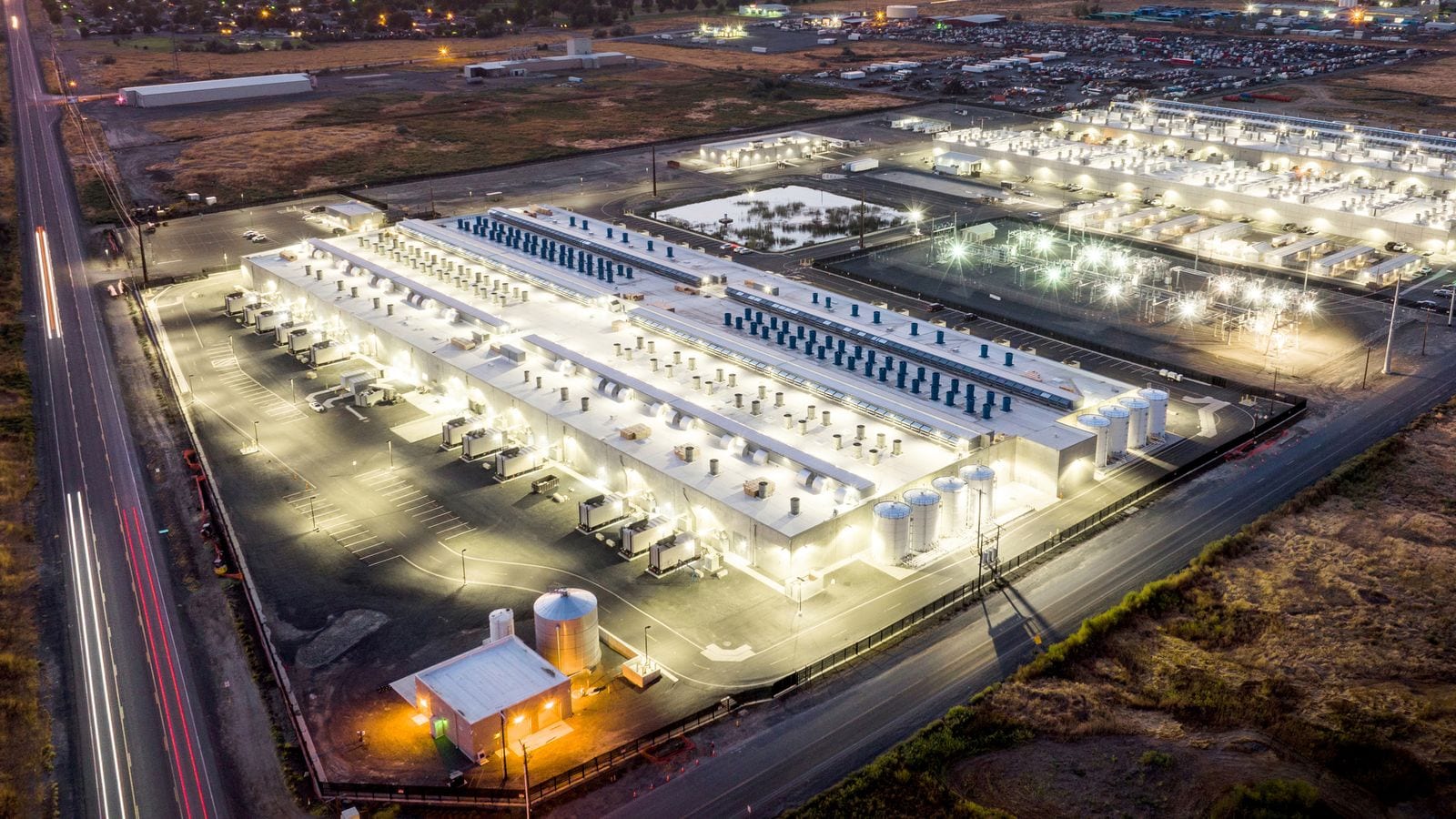
How much water did Amazon's data centers use in 2025?
Amazon said its data centers used 2.5 billion gallons of water worldwide last year. That equals about 5% of what metro Seattle consumes annually, according to Bloomberg reporting via Yahoo Finance.
The company called itself a more efficient water user than its large tech peers. Kerry Person, an Amazon Web Services vice president who oversees data center operations, pushed back on coverage he said overstated the industry's impact. "If you look at the press right now, the data center industry is apparently consuming all of the water in the world," Person said. "When you actually look at the data and look at the details, nothing could be further from the truth."
How does Amazon's water efficiency compare to Microsoft and Google?
Water usage effectiveness (WUE) is a metric that measures how many liters of water a data center withdraws per kilowatt hour of electricity consumed.
Amazon reported a WUE of 0.12 liters per kilowatt hour in 2025, down from 0.15 in 2024. Microsoft's WUE was 0.27 liters per kilowatt hour in its most recently reported fiscal year. AWS also cited an academic estimate placing the industry average at 0.84 liters per kilowatt hour.
Amazon's figure covers sites it owns or leases. It excludes colocation facilities, which accounted for about a fifth of Amazon's computing capacity in 2024. It also excludes water used to generate the electricity that powers its data centers.
Amazon's calculation includes both evaporated water and water discharged to wastewater systems. Most peers report only evaporated water, making direct comparisons difficult.
You might also like



How do Amazon's data centers actually use water for cooling?
AWS data centers that use water for cooling push outside air through a water-soaked filter on hot days — specifically when temperatures exceed 85 degrees Fahrenheit. That process cools the air before it enters server halls and evaporates some water in the process.
In water-scarce regions like the Phoenix area and Saudi Arabia, Amazon said its facilities do not draw on outside water sources. Instead, they use air-cooled chillers that circulate refrigerant and water in closed loops.
What are the broader water pressures on data centers in 2026?
Water has become the second-largest constraint on new data center development, behind only power availability, according to Control Associates. U.S. data centers consumed an estimated 17–20 billion gallons of water directly in 2024–2025. Analysts project that figure could quadruple by 2030.
Among the largest operators, Microsoft used 7.8 billion gallons in 2024, up 34% year over year. Google used an estimated 6.3–6.8 billion gallons. Amazon's disclosed figure of 2.5 billion gallons sits below those estimates, though methodology differences complicate comparisons.
Two-thirds of new U.S. hyperscale campuses built since 2022 are located in high or extreme water-stress counties, per a Bloomberg report cited by Control Associates.
What new regulations are taking effect in 2026?
Starting in 2026, EPA rules require NPDES permits for all cooling tower blowdown discharges. Limits cover discharge temperature, total dissolved solids, pH, PFAS, and legionella. Large facilities must now have Legionella Risk Management Plans.
At the state level, Virginia mandates reclaimed water use and "no net increase" clauses. Arizona has made new groundwater certificates nearly impossible for hyperscale projects. California and Minnesota require public water-use dashboards for facilities over 50 MW.
Utah recently passed a first-of-its-kind transparency law requiring new data centers of a certain size to disclose annual water withdrawals.
Is Amazon doing anything to reduce its water footprint?
Amazon has set a goal of returning more water to the environment than it withdraws by 2030. The company is doing this through projects including watershed restoration and refurbishment of wells and water systems. It currently pipes reclaimed water to 26 of its own data centers and is working on more than 100 additional water reclamation projects.
Who is calling for more transparency on data center water use?
Among the largest cloud companies, only Google and Meta currently provide water usage data for individual facilities. Iris Stewart-Frey, a professor of environmental science at Santa Clara University and lead author of a report on California's data center water usage, said more disclosure is needed. "We need more transparency," she said. "Then communities will actually know what they're getting into and can evaluate the costs and benefits, because the situation is very different from locality to locality."
After a legal battle in Oregon, the city of The Dalles agreed to release records showing how much municipal water Google's data centers were using there. Google's facility in The Dalles historically consumed more than 25% of the local municipal water supply.
Amazon's 2030 water-positive commitment and its current work on more than 100 water reclamation projects represent the concrete next steps the company has publicly confirmed.
<!--il:v1-->




0 Comments
Log in to comment
Not a member yet? Join the community
Pick a meme
KlipyHave a great take?
Drop your email — we'll send a magic link so you can post it. No password.
Not a member of the community? Join today.
Join the community →