What does it actually take to go from broker owner to vibe coder with zero income?
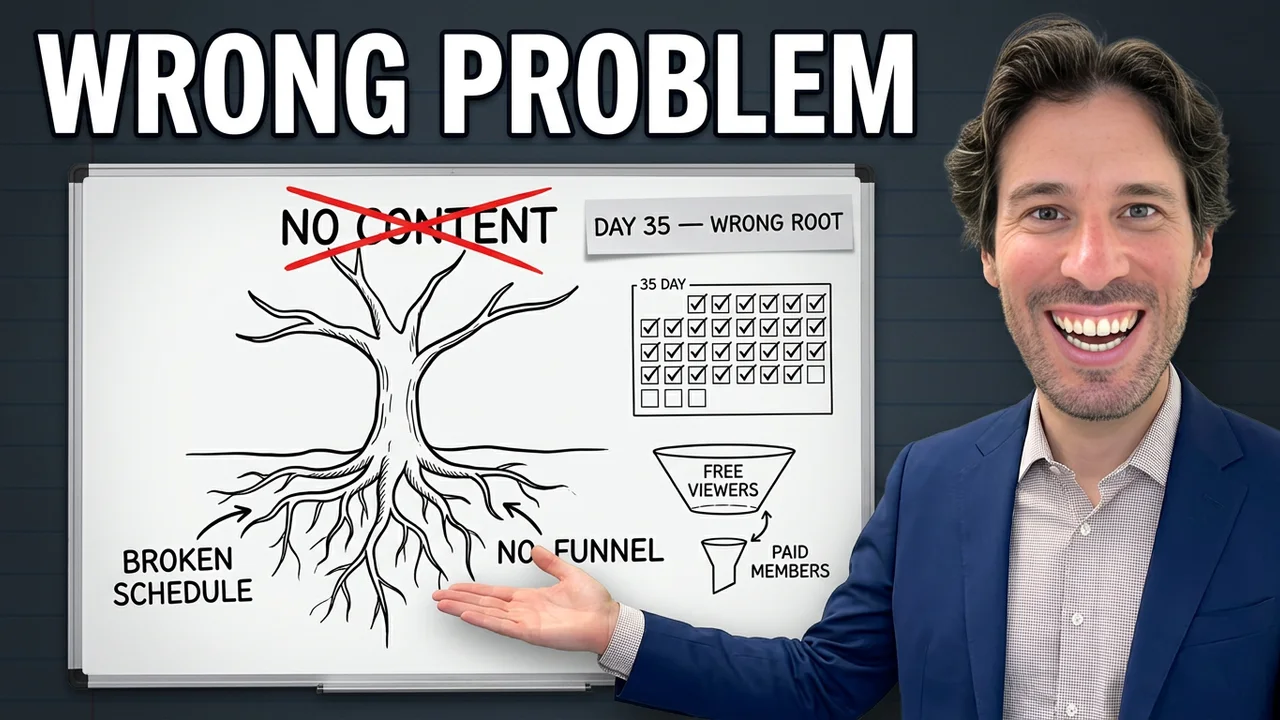
The honest starting point is zero — zero revenue, zero content trust, and a YouTube channel the algorithm no longer knows how to categorize. I spent 17 years as a broker owner in New York City. Now I'm on Day 313 of building in public as a vibe coder, and the core problem hasn't changed: I make no money unless I provide value, and I can't provide value at scale without trust.
This brainstorming session is me working that out loud. Not a polished strategy deck — a live thinking session where the solution arrives mid-sentence.
Why did 3 YouTube niche pivots destroy my algorithm trust?
YouTube built a model of me as a personal development creator first. Then I moved into faith-based content. Then I pivoted into vibe coding. At [8:22] I said: "I went into this that these are separate. It's not. This is a relationship." — and that applies not just to thumbnails and titles, but to my entire channel identity.
Each pivot reset the algorithm's understanding of who I serve. YouTube stopped knowing which audience to show my videos to. The result is what I'd call purgatory: 10,000 subscribers, a terrible click-through rate, and an algorithm waiting to see if I stabilize before it promotes me again.
How does the browser-to-paid funnel actually work for a content creator?
The funnel has 4 stages, and each one requires a different kind of value delivery:
- A browser finds content through YouTube search, Google, or an AI model like Perplexity — this is pure discovery, driven by SEO and AEO signals.
- A viewer decides the thumbnail and title are worth clicking — they watch once, maybe twice a week.
- A subscriber trusts the channel enough to return 3 or 4 times a week without being prompted.
- A payer exchanges both time and money — the most valuable conversion because it costs them both.
The browser stage is where I'm losing people right now. If the thumbnail-title relationship doesn't work, nobody enters the funnel at all.
What is the thumbnail-title relationship and why does it matter for click-through rate?
The thumbnail-title relationship is the principle that a YouTube thumbnail and its title must function as a single coordinated unit — not 2 independent creative decisions.
You might also like

I was prompting AI to generate a thumbnail separately from the title. That was the mistake. The way a viewer actually processes a video card is: thumbnail → title → thumbnail again. They scan the image, read the words, then return to the image to confirm the decision. If the thumbnail and title don't reinforce each other, the viewer bounces before clicking.
Mr. Beast is the clearest example I can point to. The image shows something visually extreme. The title explains the stakes. The viewer loops back to the image and clicks because both signals agreed. I need that same loop working in my content.
How am I fixing my thumbnail prompts with a 4-variation system?
I arrived at this solution mid-session, which is exactly why I do brainstorming out loud. I was running a single thumbnail prompt per video with no variation in background or text treatment. The result was chaotic — too many drawn elements in the background, no clear foreground-text-background layering, and no relationship to the title.
The new approach:
- Generate 4 distinct thumbnail prompts per video, each paired with a specific title variant.
- Score each thumbnail-title pair as a unit — not the thumbnail alone.
- Use VidIQ thumbnail and analytics tool to evaluate the options before uploading.
- Select the pair with the strongest visual-verbal relationship, not just the best-looking image.
A thumbnail has 3 layers: the person in the foreground, the text in the middle, and the background. I was collapsing all 3 into one undifferentiated prompt. Separating them — and tying each variation to a title — is what gives me real options.
What is AEO and why does it matter as much as SEO for my content strategy?
AEO (Answer Engine Optimization) is the practice of structuring content so that AI models — not just traditional search engines — surface it as a trusted source when users ask questions.
YouTube is the second-largest search engine. But the largest engines right now are AI models: Perplexity, Claude, OpenAI's products, and Gemini. When someone asks "what are the best sneakers for running a marathon," they may never open a browser tab. They get an answer directly from the model. If my content isn't structured to be cited by those models, I miss that entire discovery layer.
The Google Search documentation on how crawlers index content makes clear that trust signals — structured data, low bounce rates, accurate sourcing — determine what gets surfaced. AEO works on the same trust logic, just applied to model training and retrieval pipelines instead of PageRank.
What did 240,000 crawlers with no audience actually tell me about my site's trust?
I pulled my Cloudflare analytics and found 240,000 crawler visits during a period when I had no real audience — because I had no content. By my account, that number reflects bots, scrapers, and indexing agents hitting the site and finding nothing worth citing or ranking.
Crawlers and humans need different things from the same site. The crawlers read the code layer: structured markup, internal linking, semantic HTML, metadata. The humans read the interface layer: is it mobile-responsive, does it answer the question they came with, does it make them stay or bounce?
I had neither working. The crawlers found an empty trust signal. The humans never arrived. Building trust means fixing both layers simultaneously — the code base for bots, the interface for people.
What questions do builders ask about recovering a YouTube channel after a niche pivot?
How long does it take YouTube's algorithm to re-categorize a channel after a niche change? There's no fixed timeline YouTube publishes. From my experience across 3 pivots, the algorithm appears to wait for consistent signals — stable topic, stable audience retention, stable click-through rate — before it begins promoting the new direction. I'm currently in that waiting period, and the only lever I control is content quality and consistency.
Does having 10,000 subscribers help when click-through rate is low? Not much, in my honest assessment. Subscribers signal past trust, but the YouTube analytics and click-through rate documentation makes clear that the algorithm weights engagement signals heavily. A channel with 10,000 subscribers and a poor click-through rate will be served to fewer new browsers than a smaller channel with strong engagement. Subscriber count alone doesn't move the needle.
What is bounce rate and why does it affect SEO trust? Bounce rate is the percentage of visitors who land on a page and leave immediately without clicking further. A high bounce rate tells Google the content didn't satisfy the user's intent. For my site, that means every piece of content needs to actually answer the question that brought someone there — not just exist on the page.
Should I revamp old videos or focus only on new ones? I'm doing both, but the revamp is urgent. My old thumbnails are chaotic, my descriptions were too long, and my timestamps were probably not useful. Those videos are still indexed and still getting impressions. Fixing their metadata is a faster trust signal than waiting for new content to accumulate.
How does the SRT file factor into YouTube's content understanding? An SRT file contains the full transcription of a video with timestamps. I run the SRT through AI to generate titles, descriptions, and timestamp markers for the video description. The problem I identified is that this process was generating the title and thumbnail independently — no relationship between them. The SRT is the raw material; the relationship between thumbnail and title is what I have to engineer on top of it.
0 Comments
Log in to comment
Not a member yet? Join the community
Pick a meme
KlipyHave a great take?
Drop your email — we'll send a magic link so you can post it. No password.
Not a member of the community? Join today.
Join the community →